Skip to content

The Rockwell Hardness Scale, HRC, and Does It Matter For Your Knife?

All you wanted was a cool-looking Japanese knife, but suddenly retailers and knife connoisseurs are throwing facts and numbers at you. Among the dozen other statistics and buzzwords, they keep mentioning the 'HRC' number and the 'Rockwell Hardness Scale,' but you haven't got a clue what they're talking about.

What Is HRC?

When buying a knife, one of the most important factors is the hardness of the material, as this can dramatically change the performance of a knife. Therefore, an HRC rating is something to look out for when comparing knives, as it gives you an idea of how hard the steel of a knife is. But, although the Rockwell Hardness Scale provides essential information, it's a more complex issue than many think.

What’s better, a higher or lower HRC number? Does it even matter?

In this article, I will take you through the history and use of the Rockwell Hardness Scale. Then, I'll dispel a few misconceptions so you can look beyond marketing to make the right decision. Soon enough, you'll know the ins and outs of the scale, but before I get into whether or not high HRC is a good thing, let's look at how knife steels got their HRC numbers in the first place.

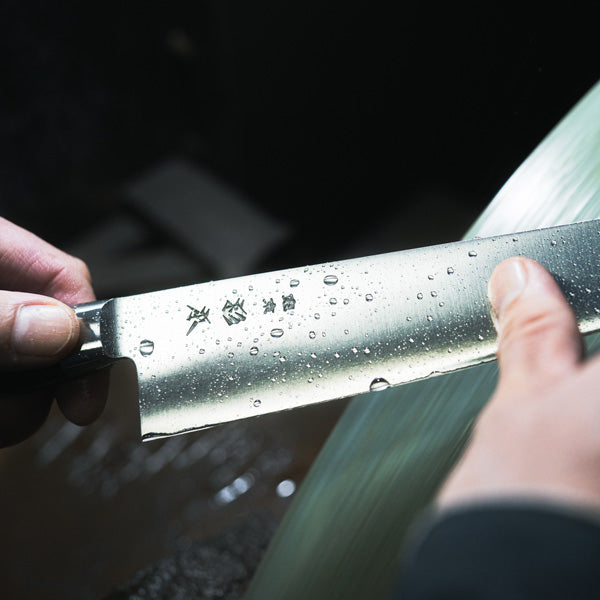
Japanese knife cutting fruits

A Brief History of the Rockwell Hardness Scale

Hugh M. Rockwell and Stanley P. Rockwell (who weren't related but conveniently had the same last name) patented the technology in 1919 for testing materials in the construction of automobile bearings. Until then, other types of hardness tests had destroyed the test materials and weren't as accurate. The Rockwell Hardness Test didn't require significant damage to the test material, so it could perform multiple tests easily on the same piece of material. In addition, the testing machine itself was sturdy and easy to use.

The Spread of the Rockwell Hardness Tester

Stanley Rockwell then went on to team up with the president of Wilson Mechanical Instrument Co., Charles H. Wilson, to commercialize the Rockwell Hardness Tester. Wilson was granted a U.S. patent in 1932 for a commercial version, which has since become a popular way for many industries to check the hardness of materials. The design of the machine has mostly stayed the same since the original patent, but the more current models feature digital LCD screens and require less input from the user.

How a Rockwell Hardness Test is Done

The test is done using a small sample of the material that needs to be tested and a hydraulic machine, the aforementioned Rockwell Hardness Tester. The machine presses a small cone-tipped indenter into the material (for example, a piece of steel) using an exact amount of force. It starts with a shallow indentation and then a deeper one, measuring the two. That's how the machine gauges the hardness of the material and gives it a number on the scale. A high number means the material is harder, and a lower number means it's softer.

HRC, or Hardness Rockwell C

HRC stands for Hardness Rockwell C. There are 30 different scales for various materials. For instance, there are scales for softer metals such as copper (HRB) or plastics (HRM). The C scale is used specifically for very hard materials such as steel. You don't have to worry about the other scales as they aren't used to measure the hardness of knife steels. That's why you'll only ever see an HRC number with regard to knives and not HRM or HRB.

HRC Test

While all of the scales are measured in the same manner, certain variables change. For example, a diamond brale indenter is used to perform the HRC test because of the hardness of the material being tested. On top of that, 150 kilograms of force is needed to make a tiny indentation into the steel. Because steel isn't necessarily wholly uniform in every spot, and to account for errors, this test is usually done several times to get a range of numbers. That's partially why you'll sometimes see HRC numbers given as, for example, a range (HRC 58 - 60) or as a minimum value (HRC 58+).

Different Knife Makers, Different HRCs

But, while a steel manufacturer might give their steel an HRC number, this is only the hardness of the steel from the factory. Once knife manufacturers and bladesmiths get their hands on the material, they can make it even harder through various heat treatments. That's why you'll find knives made from the same steel but by different knife manufacturers with varying HRC numbers.

Japanese Knife

Is High HRC Important For My Knife?

Okay, now we know that a knife with a high HRC number means it has harder steel. That means it's better, right? Well, the answer is both yes and no. It's a little more complicated than that. Generally speaking, yes, a harder knife will mean a lot of good things are coming your way: better wear resistance, good edge retention, and toughness. And additionally, a harder steel knife can often have its edge sharpened to a smaller angle, making it much better for fine cutting.

But There Are Downsides

Harder steels tend to be more brittle. So, if you choose a super-hard knife, it will be more prone to chipping, shattering, and snapping. Usually, this isn't a problem if proper care is taken with a knife. Just avoid cutting frozen foods, bones or using your knife for anything outside the kitchen. But, if you were buying a knife to use in an environment where it needs to be more durable, for example, while camping, you may want a lower HRC knife, trading off some sharpness for something less brittle.

Hard to Dull, Hard to Sharpen

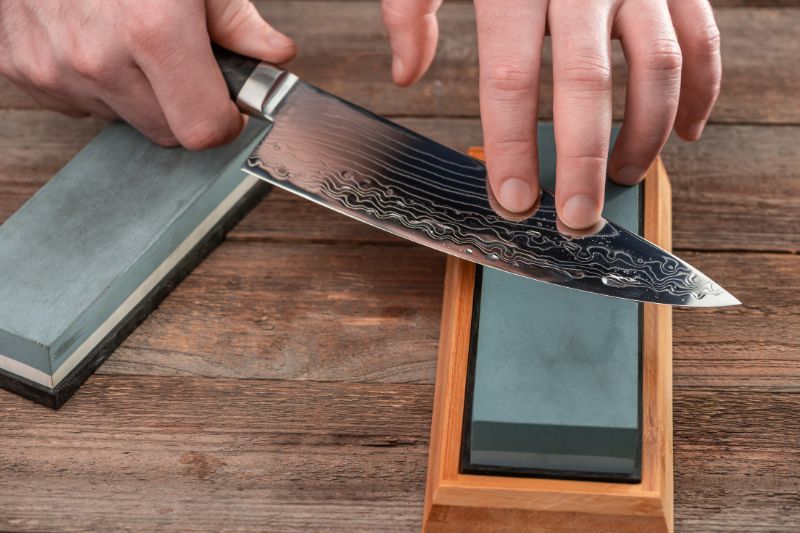
There is another consideration too. If you prefer sharpening your knife yourself, you will find that a higher HRC steel will be much more difficult to sharpen. When the HRC starts getting beyond 63, it is a good idea to ask a professional to sharpen your knife for you. That can be an extra cost of maintaining a knife that some people may not be able to afford. However, you won't often need to sharpen a very hard knife, especially if you take good care of it. Whereas a "softer" knife, around 56 - 60 HRC, you can easily maintain yourself, but it will need more frequent sharpening. Most Japanese knives sit around a sweet spot of 58 - 62 HRC, with good edge retention but still able to be sharpened at home.

The High Price of a Fine Edge

Generally speaking, the higher the steel HRC, the more expensive the knife. However, unless you're a knife expert or a professional chef, there will be diminishing returns in the cutting difference you perceive. So, while it's a great idea to invest in a good knife (they can last you a lifetime), you may not want to put all your money into a top-of-the-line knife made with the most expensive steel until you're experienced enough to appreciate the difference. Even some lower-end to mid-ranged Japanese knives are of exceptional quality. That's because a knife made by a great manufacturer will always be better than one made by a lousy manufacturer, regardless of the steel.

Technique and Other Elements

As discussed, the same steel in different hands will produce a very different knife. A perfect example is carbon steel, like White Steel. Although White Steel is not as "sophisticated" as other elaborate alloy steels, it is often found in some of the most expertly made knives. That's because it is notoriously tricky for bladesmiths to work with and requires the utmost care and expertise to shape without breaking it. So, there are much higher HRC steels than White Steel, but they aren't necessarily going to be sharper or better if they aren't made with the same precision.

The Best HRC

In some ways, It’s not about how high the HRC of steel is. It’s about the correct HRC for that type of steel. When a knife manufacturer gets the optimal HRC for a kind of steel, the different elements in that steel can do a better job. Otherwise, the steel might become too brittle or too soft. This is all done through various heat treatments in the knife-making process. If the correct HRC is achieved, all of the elements in the steel (molybdenum, cobalt, vanadium, etc.) work even better. That means the knife will have better wear resistance, edge retention, and toughness.

The Right HRC For You

It's always going to be about the use and the user. But, yes, a high HRC often indicates a quality knife with a long-lasting edge. Just keep in mind what you're using the knife for. Japanese kitchen knives come in all shapes and sizes for different tasks, and you may want a variety of knives with different hardness for each job. Know your knife budget, but be bold and invest in good quality. When you find a knife you like, ensure the manufacturer has a good reputation. And, what matters more than anything, or anyone else's opinion, is that the knife feels good to you when you use it.

The Rockwell Hardness Scale, HRC, and Does It Matter For Your Knife? — Frequently Asked Questions

What HRC range should I look for in a kitchen knife?

For Japanese kitchen knives, 60–63 HRC is the sweet spot — hard enough to take and hold a sharp edge, soft enough to sharpen on a normal whetstone. Below 58 HRC and you're looking at Western-style steel that won't hold a Japanese-thin edge for long. Above 65 HRC and the steel becomes brittle enough that small impacts chip the edge, and only a few experienced sharpeners can work with it. Premium powdered steels (SG2, ZDP-189) sometimes reach 64–66 HRC and require careful handling. For a first Japanese knife, anything in the 60–62 HRC range is forgiving.

Does a higher HRC mean the knife will chip more easily?

Yes, generally. Hardness and toughness are an inverse trade-off in steel — the harder the steel, the more brittle it is. A 65 HRC blade chips on impacts that a 58 HRC blade would just dull on. This is why Japanese knives chip and Western knives roll over: the harder Japanese steel is sharper but less forgiving. For a home cook with mixed habits, 60–62 HRC is the practical ceiling — sharp enough to feel the difference but tough enough to survive an occasional mistake. Read our edge chipping guide for the cooking habits to adjust.

How to minimize edge chipping on Japanese knives

Why isn't HRC printed on every knife?

Because manufacturers often want to obscure the number — soft steels are cheaper and easier to make, so a $40 "premium" knife with 54 HRC steel doesn't advertise its hardness. Japanese makers in the higher-end range almost always print the HRC because it's a selling point. If a listing doesn't mention HRC and the price is in the premium range, ask the seller; if they don't know, the knife probably isn't in the 60+ HRC range it's implying. Real Japanese workshops (Sakai, Seki, Echizen) publish HRC for every blade.

How is HRC actually measured?

A diamond-tipped indenter is pressed into the steel under a specific load (usually 150 kgf for HRC), and the depth of the indentation is measured. Harder steel resists the indenter more, producing a shallower mark and a higher HRC number. The Rockwell C scale runs from about 20 (soft tool steel) to 70 (the hardest commercial cutting steels). For kitchen knives, we mostly care about the 56–66 HRC range. The test is fast and non-destructive in production but does leave a tiny mark, which is why it's done on a sample blade per batch rather than every blade.

Should I prefer carbon steel over stainless because of HRC?

Not by HRC alone. Modern Japanese stainless steels like VG-10 and SG2 reach 60–63 HRC, comparable to traditional carbon steels at the same price point. The real differences are sharpening ease (carbon is easier on whetstones, with finer-grained steel) and rust resistance (stainless is more forgiving). For a first Japanese knife, stainless at 60–62 HRC gives you most of the cutting performance with much easier care. Carbon steel becomes worthwhile once you're committed to drying the knife immediately every time. Browse our Japanese knife collection.

What is Carbon Steel?

Related products
1 review

Gyuto Knife with Japanese Handle - All-purpose Premium Japanese Artisanal Knife

$360.00
Quick view

The Japanese Gyuto knife is the ultimate multi-purpose blade, perfect for everyone from beginner home cooks to seasoned chefs. As the Japanese counterpart to the Western chef’s knife—only thinner, lighter, and sharper—it excels at chopping, slicing, and dicing almost anything in the kitchen with effortless precision. This variation features a beautiful maple-wood handle that not only adds a natural, elegant aesthetic but also provides a smooth, earthy texture for enhanced control and comfort. Crafted with CM stainless steel, it offers exceptional sharpness, durability, and rust resistance, ensuring years of effortless slicing. With a blade length of 180mm (7.1 inches) and a double bevel edge, this handmade, hand-braided, and hand-sharpened Gyuto is a versatile and essential tool that elevates both the appearance and taste of your culinary creations. This product is available for shipping within the USA only.

Santoku Knife - Premium Japanese Artisanal Knife

$250.00
Quick view

The Santoku knife is revered for its control, precision, and sharpness, making it the master of slicing, mincing, and dicing in both professional and home kitchens. Traditionally favored for high-precision tasks like sushi and sashimi preparation, its versatility extends to cutting meat, fish, and vegetables with ease, supported by a comfortable, easy-to-control handle. Handmade by master bladesmiths using techniques passed down through generations, each Santoku offers extraordinary quality that elevates every slice. Named after the "Three Virtues"—meat, vegetables, and fish—the Santoku’s shorter, thicker, straight-edged blade with a sheep foot-shaped tip enhances the appearance, taste, and texture of your food while delivering exceptional performance with minimal maintenance, thanks to its CM stainless steel and Western-style handle. With a blade length of 170mm (6.7 inches), it is the ultimate daily knife for any cooking enthusiast.

Damascus Santoku Knife with Japanese Handle - All-purpose Premium Japanese Artisanal Knife

$1,199.00
Quick view

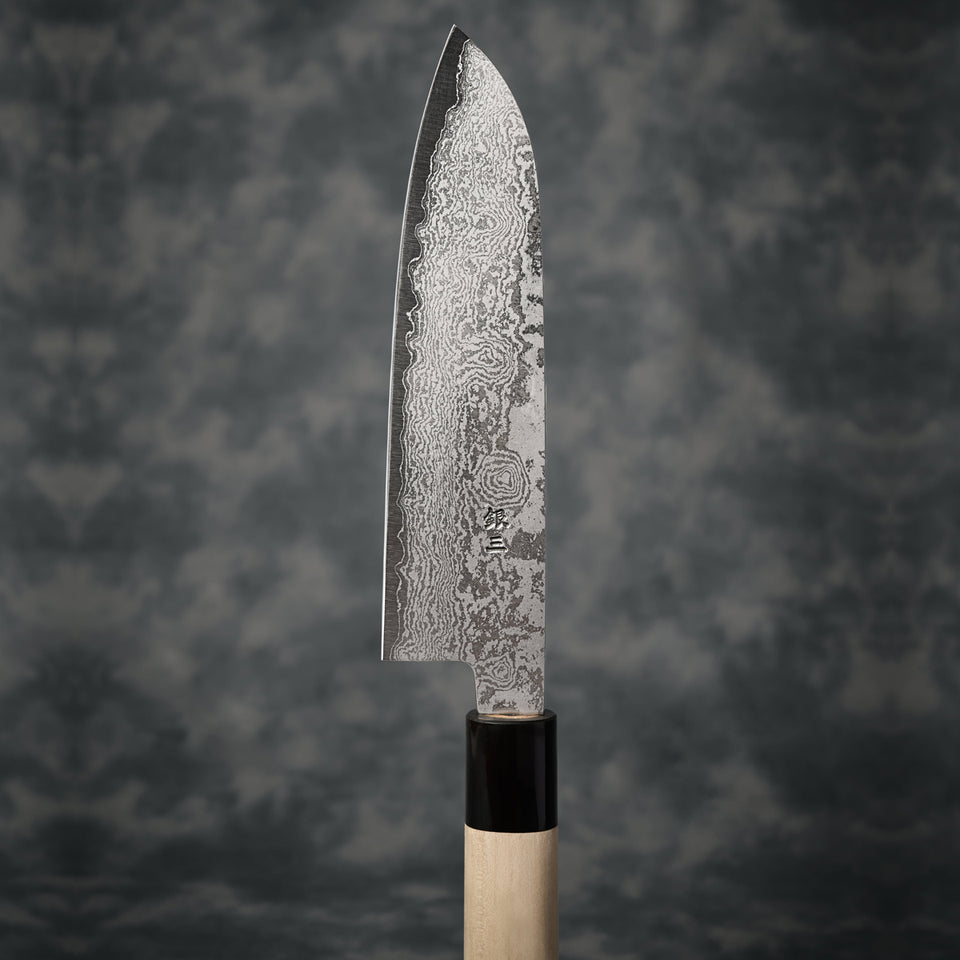
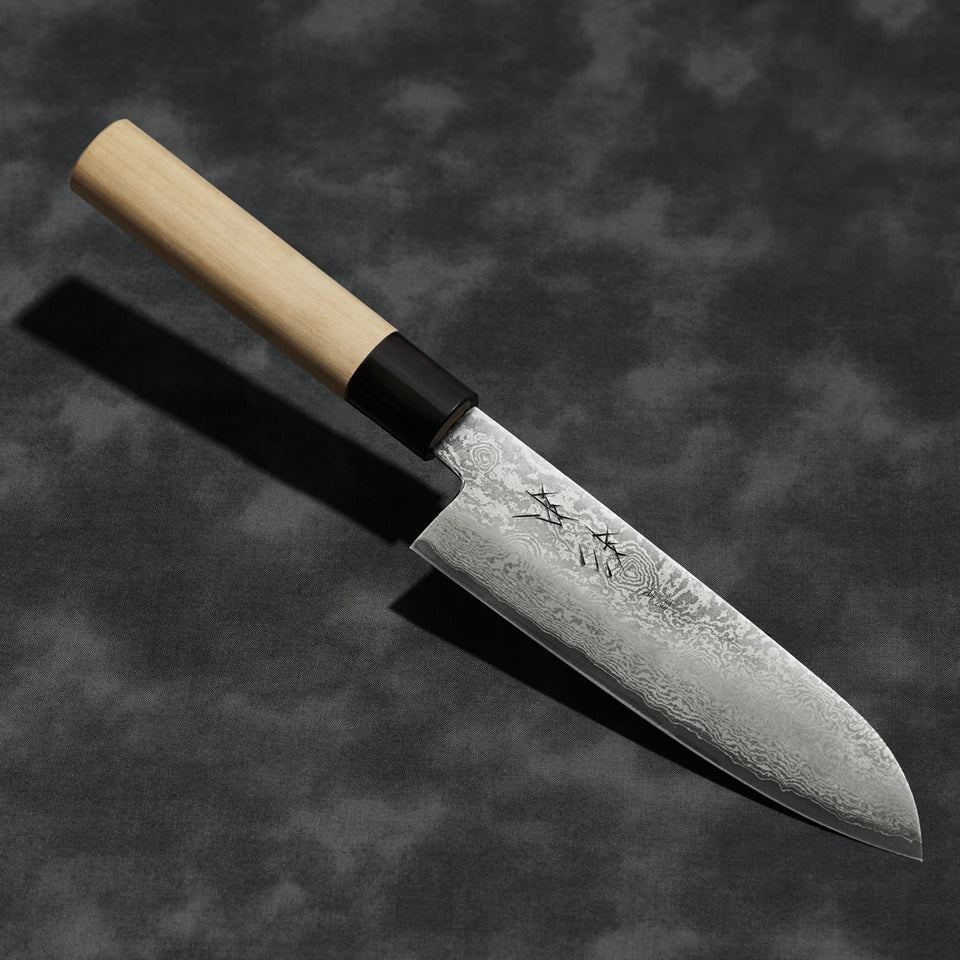
A true masterpiece of craftsmanship, our Japanese Damascus Santoku knife beautifully unites exquisite patterns with exceptional performance. Crafted entirely in Japan by skilled artisan bladesmiths, each blade showcases the iconic wave-like Damascus patterns, symbolizing timeless Japanese aesthetics and superior quality. Unlike mass-produced imitations with printed patterns, our genuine Damascus blade is meticulously forged through the traditional layering and folding process, requiring over 200 hours of expert dedication to create a knife of remarkable strength, flexibility, and beauty.

This premium Santoku, embodying the revered "three virtues," excels at slicing vegetables, meat, and fish with precision and ease, making it the perfect daily companion for both home cooks and professional chefs. Made from CM stainless steel for rust resistance and low maintenance, the knife features a high-quality magnolia wood handle, available with either a plastic or buffalo horn collar. With a blade length of 180mm (7.1 inches) and a double bevel edge, this limited-production Santoku offers unmatched versatility, durability, and artistry—bringing both function and tradition to your kitchen.

1 review

Nakiri Knife - Vegetable Cutting/Slicing/Mincing Premium Japanese Artisanal Knife

$290.00
Quick view

The Nakiri knife (菜切包丁) is a highly versatile and efficient tool, traditionally used in Japan for cutting vegetables with supreme speed and precision. Its thin, lightweight rectangular blade allows for quick, clean, and effortless slicing without the need for a rocking motion, keeping your knuckles safely away from the cutting board while delivering beautifully thin, even slices every time. Perfect for delicate vegetables and even light filleting tasks, the Nakiri offers incredible control and minimizes damage to ingredients, preserving their flavor and texture. Handmade and sharpened by master bladesmiths, this 165mm (6.5 inches) knife features a traditional Japanese magnolia wood handle with a plastic collar and is available with either CM Stainless for easy maintenance or Kasumi Superlative Carbon Steel for a more traditional sharpening experience. With its unparalleled usability from tip to tail, the Nakiri is an invaluable asset for anyone seeking speed, consistency, and elegance in their kitchen work.

Bunka Knife - Japanese Sword Kitchen Artisanal Chef's Knife, Honyaki Carbon Steel by Mr. Ueta Sukesada

$1,180.00
Quick view

This one-of-a-kind Bunka knife is hand-crafted by legendary sword master Mr. Ueta Sukesada (刀工 上田祐定), whose expertise in traditional Japanese sword-making has earned recognition from Japan’s Prime Minister’s Office, USA PBS, and numerous national TV shows including "Matsuko no Shiranai Sekai." Using centuries-old techniques passed down from samurai bladesmiths, Mr. Ueta forges each blade with softer and harder steel layers through the ancient Tatara iron-making process, resulting in a 100% pure steel base. The Bunka knife offers legendary performance, perfect for everything from slicing vegetables to carving meats, making it an indispensable tool for chefs and collectors seeking historical authenticity and unmatched craftsmanship. With its exquisite balance of traditional artistry and modern functionality, this masterfully made knife stands as one of the finest chef’s knives in Japan. Due to a recent injury Mr. Ueta sustained in 2023, production is extremely limited, making each knife a truly rare and valuable addition to any serious kitchen or collection. Blade dimensions are 184mm (7.2 inches) in length, 38mm (1.5 inches) in width, and 3mm (0.12 inches) in thickness.


Related Articles You May Be Interested

What is Carbon Steel?
How to Make Your Japanese Knives Last Longer
List of Ideas to Engrave On a Knife
How to Know Which Size of Knife Is Right for You
Everything You Need to Know About Magnolia Wood Handles

Get Free Bonus Books
Join Japanese Knife Club

Sign up for free to the Japanese Knife Club to get advice and exclusive articles about how to choose Japanese Knives, and tips and tricks for using Japanese knives.

Unsubscribe anytime. It’s free!

About the author

Kei Nishida

Kei Nishida

Author, CEO Dream of Japan

info@japanesegreenteain.com

Certifications: PMP, BS in Computer Science

Education: Western Washington University

Kei Nishida is a passionate Japanese green tea connoisseur, writer, and the founder and CEO of Japanese Green Tea Co., a Dream of Japan Company.

Driven by a deep desire to share the rich flavors of his homeland, he established the only company that sources premium tea grown in nutrient-rich sugarcane soil—earning multiple Global Tea Champion awards.

Expanding his mission of introducing Japan’s finest to the world, Kei pioneered the launch of the first-ever Sumiyaki charcoal-roasted coffee through Japanese Coffee Co. He also brought the artistry of traditional Japanese craftsmanship to the global market by making katana-style handmade knives—crafted by a renowned katana maker—available outside Japan for the first time through Japanese Knife Co.

Kei’s journey continues as he uncovers and shares Japan’s hidden treasures with the world.

Learn more about Kei

Related Posts

Everything you need to know about swordsmith Kawashima Kazuki (川島一城)

The definitive guide to swordsmith Kawashima Kazuki (川島一城) — 15th-generation bladesmith of Bizen Osafune. Philosophy, pr

Read More
Exciting News: We Acquired the History of Katana YouTube Channel!

Welcome to the famed History of Katana YouTube Channel—unlocking rare stories, epic blades, and what comes next. Curious

Read More
OC Japan Fair Fall 2025 Recap (October 17 - 19 2025)

We were thrilled to return to OC Japan Fair 2025—the biggest Japan-themed event in SoCal! Here is a recap video from the

Read More
Leave a comment

Your email address will not be published..

Your cart is currently empty.

Start Shopping

Select options