Skip to content

Japanese Knives vs. China's Yangjiang Knives


Are all Asian-made knives the same? For example, Japanese knives enjoy a reputation for being excellently crafted; can the same be said for Chinese knives? Is China also known for being a good source of kitchen blades?

Yangjiang Knives 

If there's anything to be manufactured, you can be certain they're making it in China. This is definitely true for knives. In fact, there's one city that is pretty much devoted to their production. Yangjiang, in the southern province of Guangdong, is known as the country's knife and scissors capital.

The city has been associated with the bladesmith craft for a long time. However, if you have misgivings, considering the reputation that "Made in China" has garnered in recent decades, understand that Yangjiang boasts a knife-making history that dates back to 600 AD. That's more than 1,400 years of mastery.

Other places in China also manufacture knives, but more than 70 percent of Chinese-made knives come from Yangjiang. Nonetheless, only five percent of the companies there manufacture knives under their own brand, 70 percent are involved in OEM (original equipment manufacturing), and the remaining 25 percent, in ODM (original design manufacturing).

To differentiate, the manufacturer sells OEM products based on the specifications of the buyers, while OED means that the manufacturer makes pre-designed products to be sold under the purchasing company's brand.

The city makes over 4,000 kinds of knives, scissors, and other cutting implements. These include kitchen and pocket knives, hardware cosmetics tools, etc. Making as many knives as the city does, not all of its products stay within China. In fact, 85 percent are exported to more than 100 countries worldwide.

Yangjiang is undoubtedly internationally renowned for its knives, so much so that it even holds an annual international knives and scissors fair. Japan, which itself is known to produce exemplary knives both in the traditional and Western styles, has always been represented in the fair by some of its artisans.

Asian Knives, Collectively

When researching which kitchen knives to get, the competition raised is often between European/American knives and Asian knives, which typically refer to Japanese knives. Nonetheless, these do share many similarities with Chinese knives. 

The main differences between European and Asia knives lie in the steel used to make the blade and in the blade edge angle. European knives have blades of softer steel. As a result, they're more durable, bouncing back from hard contact, whereas the harder Asian steel is more brittle and prone to chipping or breaking. 

It may be longer-lasting, but softer steel doesn't retain sharpness for very long, thus requiring frequent honing. On the other hand, the more rigid steel can stay very sharp for a long time. When used for their intended purpose, hard-steel knives can last a long time too, and they won't require regular sharpening either.

Since European blades are softer, they are also made to be thicker and, thus, heavier. Asian knives, on the other hand, are thinner and lighter, which means they are not as tiring to use.

Blades-wise, European knives are more angled upward than Asian knives, which are designed to have more contact with the cutting board. More contact allows faster and more efficient cutting.

Japanese Knives

Like the Chinese, the Japanese have a long history of knife craftsmanship. They have been making their own kitchen knives since the 16th century. Still, the Japanese art and trade of knife-making actually go all the way back to the Heian period (794-1185) when the Hocho-Shiki knife ceremony was recorded to have taken place. This involved the presentation of fish and meat dishes to the emperor at that time.

Later on, through the inevitable spread of cultures, Japan also started creating knives that could cater to the demands of other types of cooking. And as the Japanese do, they found ways to make these borrowed items their own, improving them to work with traditional Japanese dishes as well.

Differences between Japanese and Chinese Knives

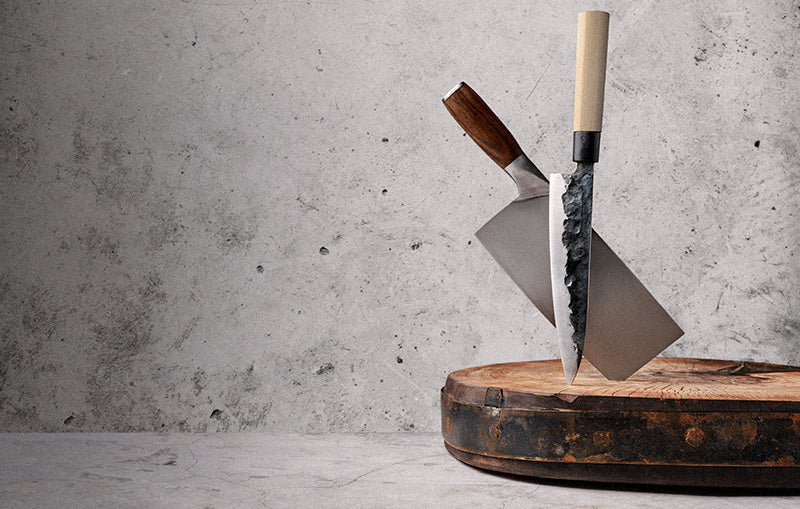
Although they may be lumped together and distinguished collectively as Asian, there are notable differences between them. For instance, let's look at the contrasting traits of a Chinese Cai Dao (vegetable cleaver) and a Japanese Nakiri (vegetable knife).

Japanese Knives vs. China's Yangjiang Knives

Chinese Cai Dao (Vegetable Cleaver)

Chinese Cai Dao (Vegetable Cleaver)


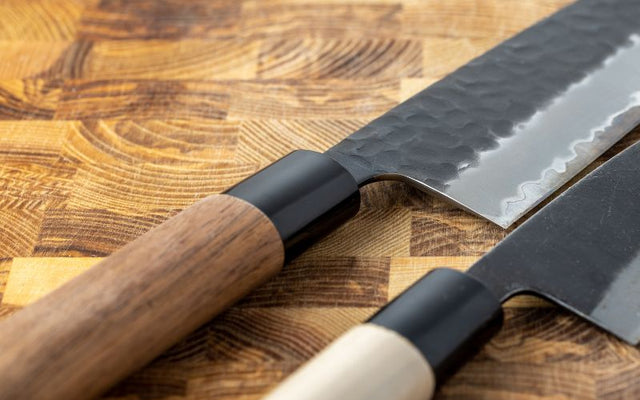
Japanese Nakiri (Vegetable Knife)

These two knives look very similar at first glance, but those in the know can easily tell them apart just from their height and weight. Nakiri knives are a bit lighter with shorter blades than Chinese cleavers. Both would work well as an alternative to a proper chef's knife but note that a Chinese vegetable cleaver is better at giving denser cuts, while the Nakiri knife can slice the daintiest pieces and carve the most intricate designs.

When it comes to shape, both have a blunt tip, although the Nakiri also features a little curve towards the end of the blade.

These are the main distinctions between these two specific kinds of knives. However, Chinese cleavers come in three kinds: the Cai Dao, the meat cleaver, and the all-purpose cleaver. The heaviest is the meat cleaver, and the lightest, the vegetable cleaver. For comparison, we can also pit the all-purpose Chinese Cleaver with the Japanese Chef's Knife (Gyuto).

Both knives were designed to be versatile, but they look nothing alike. The Chinese Cleaver has enjoyed increasing in popularity in recent years, thanks to certain social media influencers who use it to prepare traditional Chinese dishes. Viewers see how deftly they wield it to do anything from slicing, chopping, and mincing to crushing and transferring cut pieces. So naturally, they end up wanting to get one for themselves.

Meanwhile, the Chef's Knife is understandably the knife that chefs worldwide invest in, always ensuring they have it in their kitchen. That's why you'll see Top Chef contestants unpacking or packing them as they arrive or get eliminated. After all, a chef is no good without a proper set of kitchen knives, the most important of which is the Chef's Knife. This is also an all-purpose knife now used for mincing, dicing, and slicing but was initially intended for disjointing and slicing large chunks of meat.

The Japanese version of the Chef's Knife is the Gyuto, and it's different from the Chinese Cleaver in its shape, blade, and versatility. The Chinese Cleaver has a broad, rectangular, and heavier blade, while the Gyuto has a more tapered and thinner blade. 

Japanese Knives vs. China's Yangjiang Knives

All-Purpose Chinese Cleaver


Japanese Knives vs. China's Yangjiang Knives

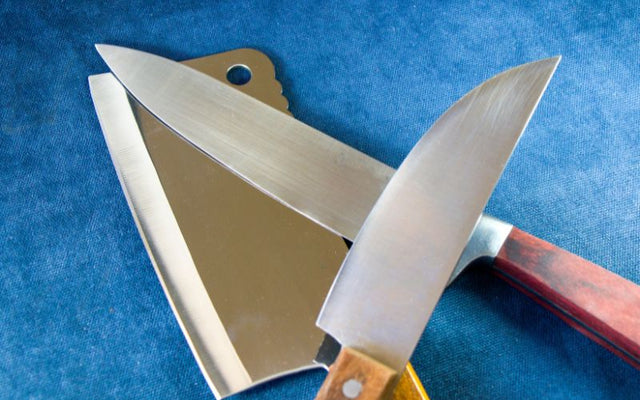
Gyuto (Japanese Chef’s Knife)

The Gyuto's tapered blade design makes it ideal for performing a variety of tasks, including slicing, dicing, mincing, disjointing, peeling, cleaving meat from the bone, and cutting through hard ingredients. It's also more appealing to those with smaller hands since it's light and much easier to manipulate.

Meanwhile, the Chinese Cleaver is a knife that can definitely handle tougher ingredients. It's essentially a force multiplier. That's why the ideal cutting technique when using it is the push cut or horizontal chop.

Japanese-made Knives vs. Yangjiang-made Knives

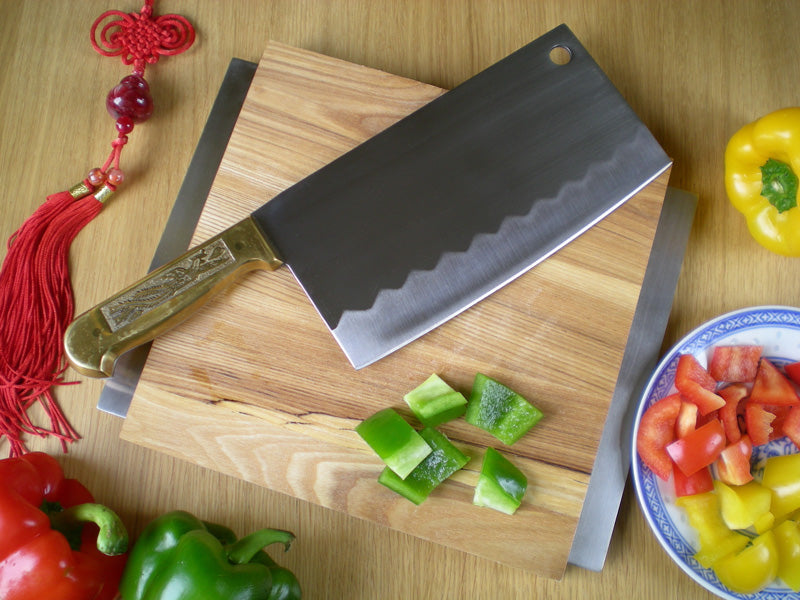
Yangjiang has an entire knife-making industry, and the city produces all kinds of knives, including Western-style knives and Japanese knives. At the same time, Japan is also making its own version of trusted and worthwhile knives from different countries. For instance, there is now the Chuka Bocho, the Japanese rendition of the Chinese Cleaver. The name literally translates to "Chinese kitchen knife."
Japanese Knives vs. China's Yangjiang Knives

Chuka Bocho

Generally, what buyers are most concerned about is quality. Considering that Japanese and Chinese knives share many similarities in contrast with their Western counterparts, it would really have to boil down to quality. 

Japanese knives can always be expected to be excellently made, more often than not hand-crafted by master bladesmiths. However, while Chinese Yangjiang knives can also be high quality, especially the ones from established and reputable brands, the high competition among themselves sometimes has some companies choosing to go with inferior materials and sacrifice some quality to make way for a higher profit margin.

For quality control, Yangjiang does have the Knives and Scissors of Standardization of Guangdong Province, which falls under the Guangdong Provincial Bureau of Quality and Technical Supervision. Nationally, there is the National Knives, Scissors, and Commodity Metal Tools Quality Supervision and Inspection Center. There are also industry associations that help establish standards, so those looking to invest in Yangjiang Chinese knives may want to look for approval or membership from these agencies.

Conclusion

Whether you end up going with a Chef's Knife that's made in China or a Chinese Cleaver made in Japan, the kind of knife you're getting is the first choice you have to make, and this would be mainly based on the different functions you require of the knife and the level of ease your hand has in handling it.

The next choice, of course, is where to source it. Japanese knives guarantee good quality. While Yangjiang knives are known to be industry leaders too, you should make sure that you get your knives from a reputable brand. This means that some more involved due diligence is required on the buyer's part.

Japanese Knives vs. China's Yangjiang Knives — Frequently Asked Questions
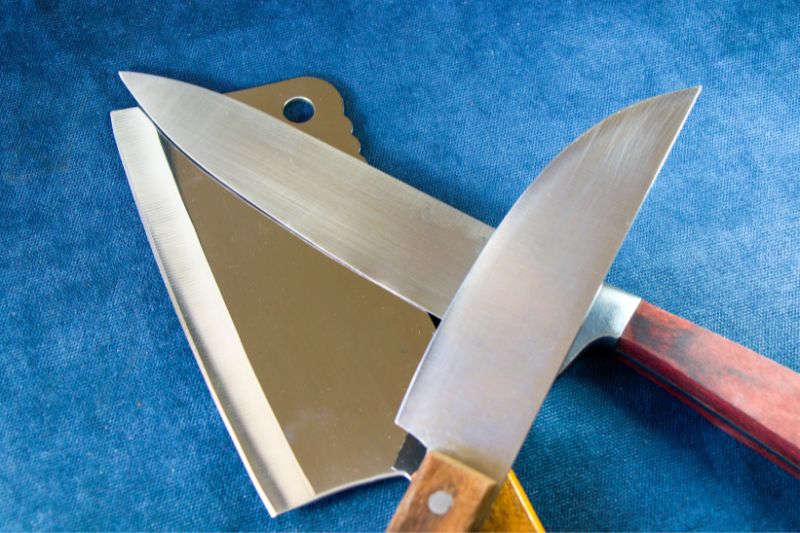
Are all "made in China" knives actually low-quality?

No, and that's an outdated stereotype. Yangjiang has been making blades for over 1,400 years, and the city produces a huge range of quality — from $5 promotional knives all the way to genuinely well-made mid-range kitchen knives. The problem is that most exported Yangjiang production is on the low end, sold under foreign brand names through OEM contracts, and the buyer has no easy way to tell which factory actually made the knife. Quality Yangjiang knives exist; finding them through the noise is the hard part.

How can I tell if a "Japanese" knife was actually made in China?

A few clues. A real Japanese knife will name the maker (often in kanji), the workshop city (Sakai, Seki, Echizen, Tosa, etc.), and the steel type (VG-10, white #2, blue #2, ginsan, SG2). A Yangjiang knockoff usually says "Japanese-style," "inspired by Japan," or "premium 67-layer Damascus" with no maker name and no specific steel type. The price is also a giveaway — a real hand-finished Japanese knife in any decent steel costs $130+; a "premium handmade Japanese chef knife" listed for $35 cannot be both. Our fake-knife guide covers the full checklist.

Liquid error (snippets/blog-post-banner line 58): invalid url input

Are Yangjiang knives ever genuinely good for home cooking?

Yes, in the mid-tier — there are Yangjiang factories making $40–80 stainless kitchen knives that perform respectably for the price. The catch is that they're sold honestly as Chinese mid-range, not dressed up as fake-Japanese premium. Brands like Shibazi (a long-established Yangjiang maker) make solid working knives that are popular in Chinese home kitchens. The trouble starts when a $40 Yangjiang knife is rebranded with a Japanese-sounding name and resold for $200 as "premium handmade Damascus" — that's the buyer getting cheated, not the knife being bad.

Why are Japanese knives so much more expensive than Yangjiang ones?

Three things, mostly. First, the steel — Japanese knives use higher-purity, harder steels (VG-10, white paper, blue paper, SG2) that cost the maker $20–40 just for the blank. Second, the labor — a hand-finished Japanese knife passes through several artisans (forger, sharpener, handle-fitter), each adding hours of skilled work. Third, the scale — a Japanese workshop might make 50–200 knives a week; a large Yangjiang factory makes 50,000. None of that is markup; it's the actual cost. Our why Japanese knives cost more breaks the math down.

Liquid error (snippets/blog-post-banner line 58): invalid url input

I bought what I thought was a Japanese knife — how do I check if it's a Yangjiang knockoff?

Check four things in this order. One: the maker — is there a real workshop name on the blade or in the listing? Cross-reference it against the workshop's own website. Two: the steel — is it named (VG-10, ginsan, SG2, white #2) and credible at the price point? Three: the Damascus pattern — does it flow naturally and asymmetrically across the blade, or does it look uniformly repeated like a printed pattern? Four: the weight — a 210 mm gyuto in stainless should weigh roughly 165–200 grams; if your knife is under 140 g it's probably cheaper steel. None of these alone is conclusive, but two or three failing together is a strong signal. Compare to a verified gyuto from our collection as a reference.

Liquid error (snippets/blog-post-banner line 58): invalid url input

Related products
1 review

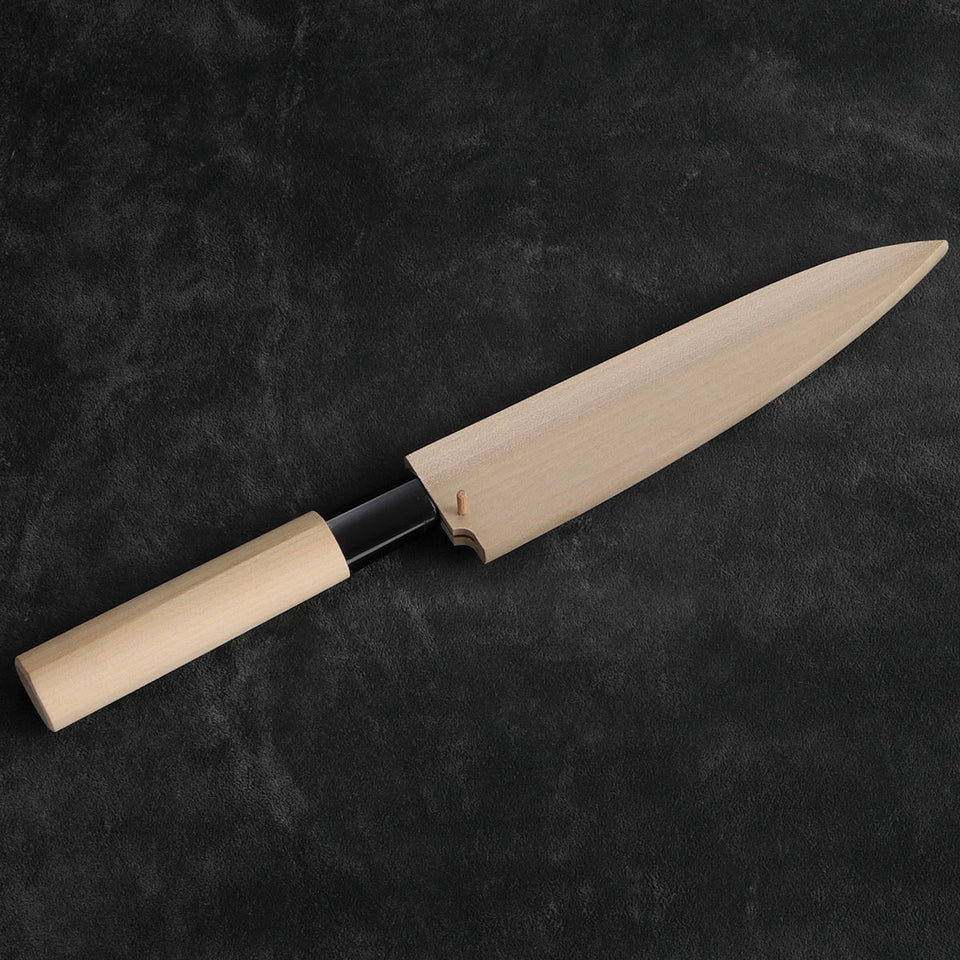
Gyuto Knife with Japanese Handle - All-purpose Premium Japanese Artisanal Knife

$360.00
Quick view

The Japanese Gyuto knife is the ultimate multi-purpose blade, perfect for everyone from beginner home cooks to seasoned chefs. As the Japanese counterpart to the Western chef’s knife—only thinner, lighter, and sharper—it excels at chopping, slicing, and dicing almost anything in the kitchen with effortless precision. This variation features a beautiful maple-wood handle that not only adds a natural, elegant aesthetic but also provides a smooth, earthy texture for enhanced control and comfort. Crafted with CM stainless steel, it offers exceptional sharpness, durability, and rust resistance, ensuring years of effortless slicing. With a blade length of 180mm (7.1 inches) and a double bevel edge, this handmade, hand-braided, and hand-sharpened Gyuto is a versatile and essential tool that elevates both the appearance and taste of your culinary creations. This product is available for shipping within the USA only.

Santoku Knife - Premium Japanese Artisanal Knife

$250.00
Quick view

The Santoku knife is revered for its control, precision, and sharpness, making it the master of slicing, mincing, and dicing in both professional and home kitchens. Traditionally favored for high-precision tasks like sushi and sashimi preparation, its versatility extends to cutting meat, fish, and vegetables with ease, supported by a comfortable, easy-to-control handle. Handmade by master bladesmiths using techniques passed down through generations, each Santoku offers extraordinary quality that elevates every slice. Named after the "Three Virtues"—meat, vegetables, and fish—the Santoku’s shorter, thicker, straight-edged blade with a sheep foot-shaped tip enhances the appearance, taste, and texture of your food while delivering exceptional performance with minimal maintenance, thanks to its CM stainless steel and Western-style handle. With a blade length of 170mm (6.7 inches), it is the ultimate daily knife for any cooking enthusiast.

1 review

Nakiri Knife - Vegetable Cutting/Slicing/Mincing Premium Japanese Artisanal Knife

$290.00
Quick view

The Nakiri knife (菜切包丁) is a highly versatile and efficient tool, traditionally used in Japan for cutting vegetables with supreme speed and precision. Its thin, lightweight rectangular blade allows for quick, clean, and effortless slicing without the need for a rocking motion, keeping your knuckles safely away from the cutting board while delivering beautifully thin, even slices every time. Perfect for delicate vegetables and even light filleting tasks, the Nakiri offers incredible control and minimizes damage to ingredients, preserving their flavor and texture. Handmade and sharpened by master bladesmiths, this 165mm (6.5 inches) knife features a traditional Japanese magnolia wood handle with a plastic collar and is available with either CM Stainless for easy maintenance or Kasumi Superlative Carbon Steel for a more traditional sharpening experience. With its unparalleled usability from tip to tail, the Nakiri is an invaluable asset for anyone seeking speed, consistency, and elegance in their kitchen work.

1 review

Petty Knife with Japanese Handle - Premium Artisanal Knife

$179.00
Quick view

The Japanese-style Petty Knife is a premium artisanal blade designed for maximum control and precision, perfect for peeling, slicing, shaping, and trimming in tight spaces. Its fine-tipped 150mm (5.9 inches) blade unlocks new levels of creativity in shaping and presentation, helping elevate the beauty of every dish you create. Featuring a traditional maple-wood handle, it offers a smooth, natural texture that feels as good as it looks, making it a joy to use. Handmade and sharpened by master bladesmiths, this knife guarantees prolonged sharpness, durability, and effortless slicing for years, making it an essential tool for passionate home cooks and professional chefs who take pride in every cut. Crafted from CM stainless steel for rust resistance and low maintenance, the Japanese Petty Knife blends beauty, functionality, and lasting performance into one exceptional kitchen companion.

Damascus Santoku Knife with Japanese Handle - All-purpose Premium Japanese Artisanal Knife

$1,199.00
Quick view

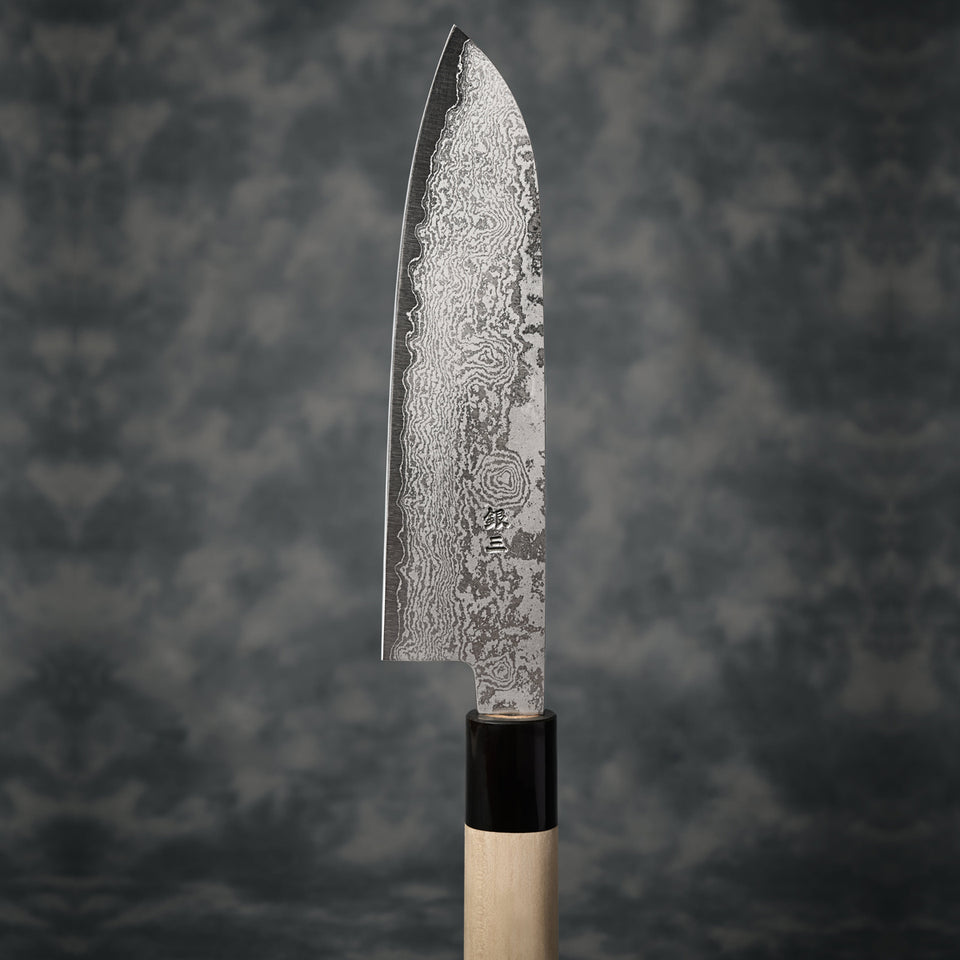
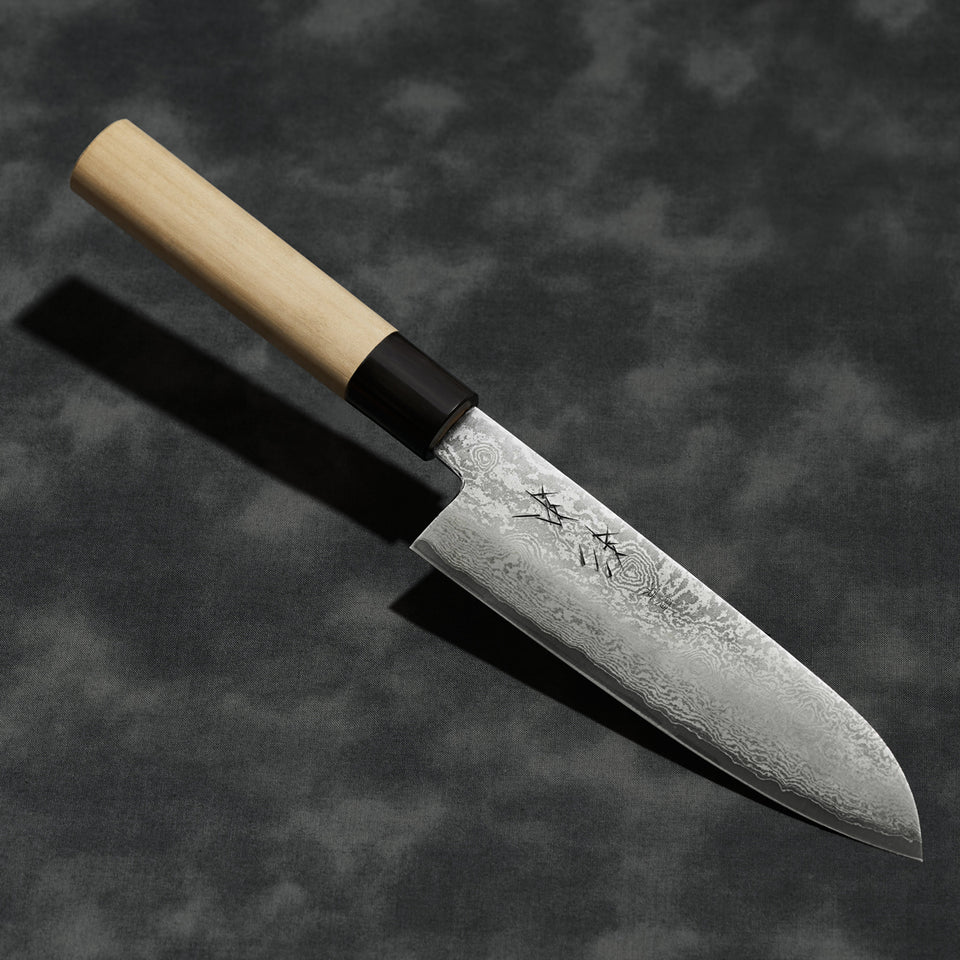
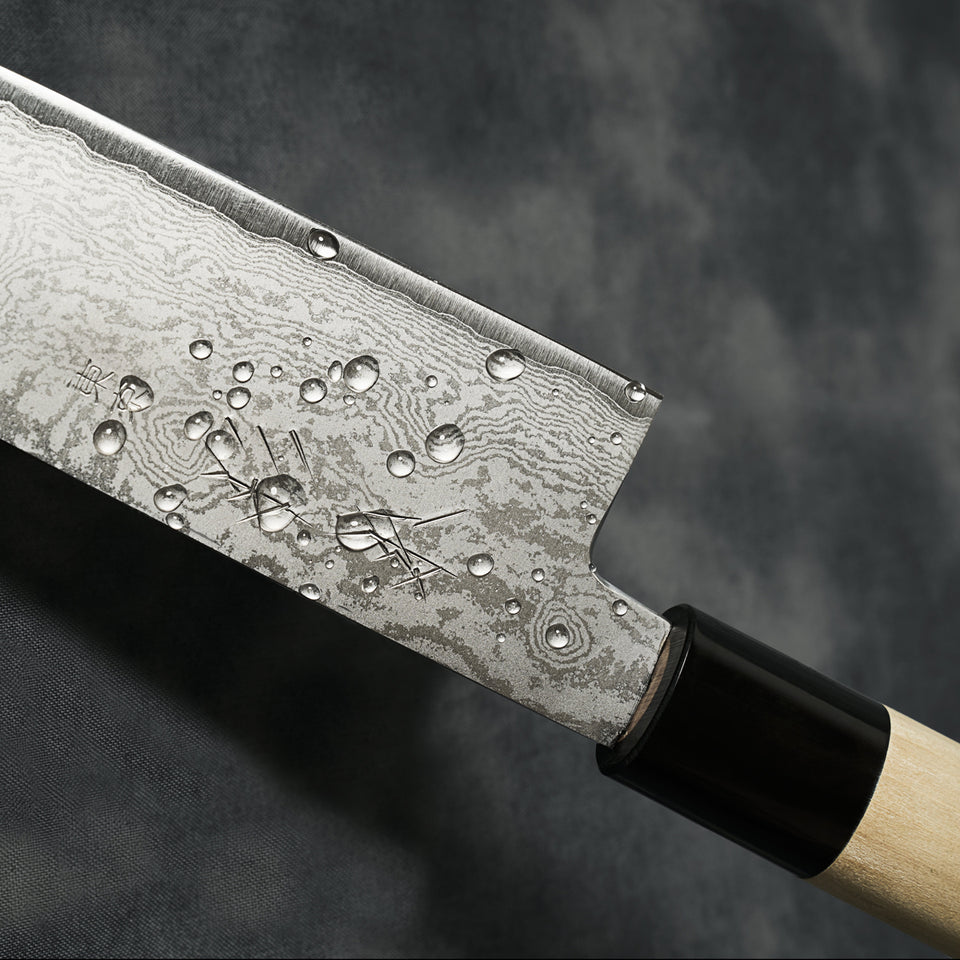
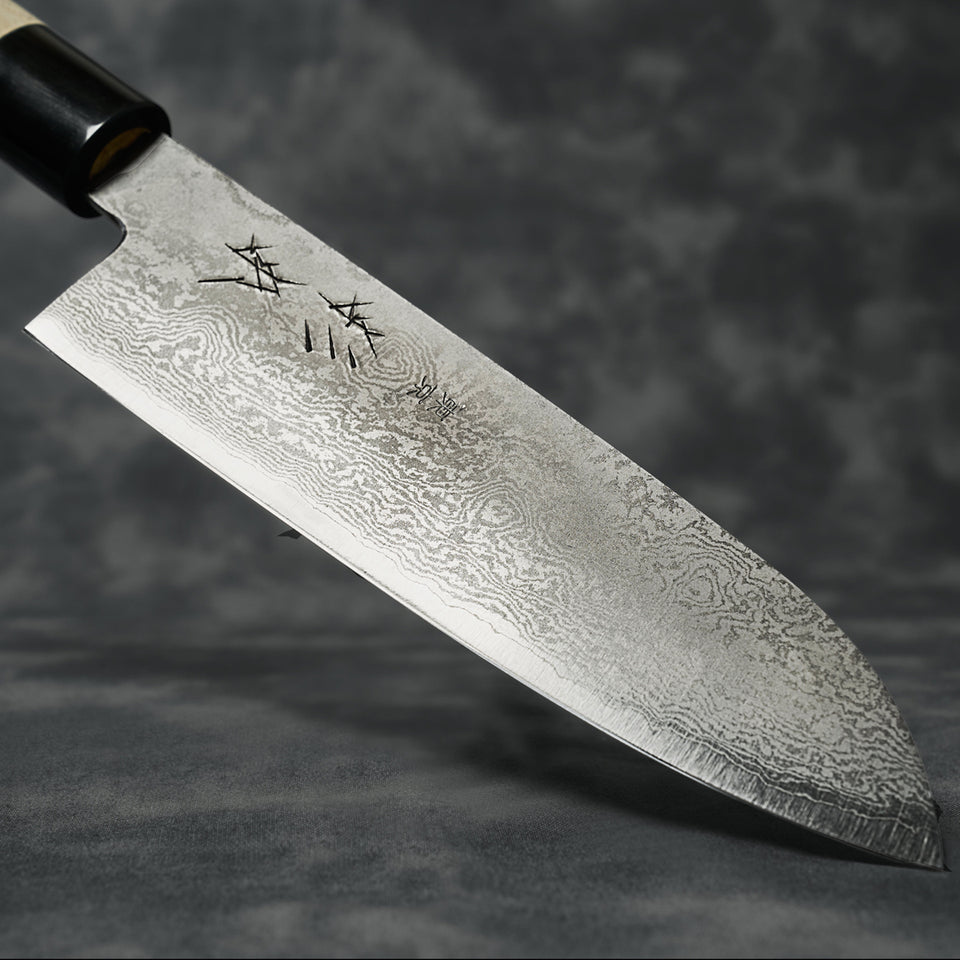
A true masterpiece of craftsmanship, our Japanese Damascus Santoku knife beautifully unites exquisite patterns with exceptional performance. Crafted entirely in Japan by skilled artisan bladesmiths, each blade showcases the iconic wave-like Damascus patterns, symbolizing timeless Japanese aesthetics and superior quality. Unlike mass-produced imitations with printed patterns, our genuine Damascus blade is meticulously forged through the traditional layering and folding process, requiring over 200 hours of expert dedication to create a knife of remarkable strength, flexibility, and beauty.

This premium Santoku, embodying the revered "three virtues," excels at slicing vegetables, meat, and fish with precision and ease, making it the perfect daily companion for both home cooks and professional chefs. Made from CM stainless steel for rust resistance and low maintenance, the knife features a high-quality magnolia wood handle, available with either a plastic or buffalo horn collar. With a blade length of 180mm (7.1 inches) and a double bevel edge, this limited-production Santoku offers unmatched versatility, durability, and artistry—bringing both function and tradition to your kitchen.


Related Articles You May Be Interested

Japanese Single Bevel Knife vs Thai Cleaver
Corrosion vs. Oxidation
The Difference Between Western and Japanese Knives
Single Bevel vs Double Bevel Knives
Blade styles - Western vs. Japanese Knives

Get Free Bonus Books

Join Japanese Knife Club

Sign up for free to the Japanese Knife Club to get advice and exclusive articles about how to choose Japanese Knives, and tips and tricks for using Japanese knives.

Unsubscribe anytime. It’s free!

About the author

Kei Nishida

Author, CEO Dream of Japan

info@japanesegreenteain.com

Certifications: PMP, BS in Computer Science

Education: Western Washington University
Kei Nishida is a passionate Japanese green tea connoisseur, writer, and the founder and CEO of Japanese Green Tea Co., a Dream of Japan Company.

Driven by a deep desire to share the rich flavors of his homeland, he established the only company that sources premium tea grown in nutrient-rich sugarcane soil—earning multiple Global Tea Champion awards.

Expanding his mission of introducing Japan’s finest to the world, Kei pioneered the launch of the first-ever Sumiyaki charcoal-roasted coffee through Japanese Coffee Co. He also brought the artistry of traditional Japanese craftsmanship to the global market by making katana-style handmade knives—crafted by a renowned katana maker—available outside Japan for the first time through Japanese Knife Co.

Kei’s journey continues as he uncovers and shares Japan’s hidden treasures with the world.

Learn more about Kei

Related Posts

Exciting News: We Acquired the History of Katana YouTube Channel!

Welcome to the famed History of Katana YouTube Channel—unlocking rare stories, epic blades, and what comes next. Curious

Read More
OC Japan Fair Fall 2025 Recap (October 17 - 19 2025)

We were thrilled to return to OC Japan Fair 2025—the biggest Japan-themed event in SoCal! Here is a recap video from the

Read More
Japanese Single Bevel Knife vs Thai Cleaver

Uncover the legacy behind Japan and Thai`s finest blades—crafted with centuries‑old secrets and passion. Discover each u

Read More
Leave a comment

Your email address will not be published..

Your cart is currently empty.

Start Shopping

Select options