Table of contents

Introduction
Ask how long it takes to become a swordsmith in Japan, and a number comes back: five years. It is not that simple.
The number is real. It is written into the ordinance, and the Cultural Affairs Agency holds to it.
It is also the smallest part of the answer.
Five years is the minimum time under a master before you are allowed to sit the training session that works as the licensing exam. Before those five years is the part nobody attaches a number to, which is finding a swordsmith willing to take you at all. After them comes the part that ends more careers than the forge ever does: paying for a workshop, and then finding people to buy what comes out of it.
I pulled this together from the guidance the Zen Nihon Tosho Kai (全日本刀匠会), the All Japan Swordsmiths Association, publishes for people who want in, plus the ordinance behind the license and what working smiths have said in public about the money.

The Short Answer: The Five Steps
- Apprentice yourself to a smith approved by the Cultural Affairs Agency. Not any smith. One who already holds the approval.
- Train for roughly five years. Full-time, unpaid.
- Pass the forging examination. This is the Agency's Bijutsu Token Tosho Gijutsu Hozon Kenshukai (美術刀剣刀匠技術保存研修会). It runs eight days, and the trade calls it the tosho exam.
- Receive manufacturing approval (作刀承認). Until you have this, forging a sword is illegal.
- Secure a supply of tamahagane. Independence starts here, not at step four.
That last step catches people off guard. Approval permits you to make swords. It does not hand you the steel to make them from. Tamahagane (玉鋼) comes out of the tatara run by the Society for Preservation of Japanese Art Swords (NBTHK, 日本美術刀剣保存協会, known in Japan as Nittoho). It is allocated rather than simply purchased, which puts a second gate behind the first. A small number of smiths get around it by smelting their own, but that is a specialism inside a specialism.
Few people get this far. There is no annually published official count of active swordsmiths, and most recent estimates place the number somewhere between about 180 and 300, with around 200 often cited. Either way, it is one of the smallest licensed professions in Japan.
Three Words for One Swordsmith
Japanese has at least three words that English translates as "swordsmith."
Toko (刀工) is the neutral word for it. It is what museums, catalogs, and scholarship use, and it is the word that appears when the writer wants to be precise rather than admiring.
Katanakaji (刀鍛冶) is the name of the work. Kaji is the smith at the fire, the same word that covers the village blacksmith and, in modern usage, the metalworker on a construction site.
Attach katana, and you have specified which kind. It is the plain-language term, the one you would use describing the job to someone who does not know the trade.
Tosho (刀匠) carries something more. Sho (匠) is the character for a master artisan, and it does what that character always does: it confers standing. This is the word for a maker recognized as an artist, not a fabricator.
The dictionaries define all three in terms of each other, so nobody should claim a formal boundary between them. But watch how the trade actually uses them.
The governing body is the All Japan Tosho Association, the honorific. The page on its site addressed to people hoping to enter the trade is titled for those who want to become a katanakaji, the plain word.
The NBTHK sorts applicants into those who hold the tosho qualification and those still training in hope of it.
The institution takes the master's title. The person walking in off the street gets the word for the labor. Five years stand between the one word and the other.
Not That Kind of Blacksmith
English searches tangle two trades that share a word.
Kajiya (鍛冶屋) in modern Japanese usually means a metalworker. This trade shows up on construction sites, where arc-welding and gas-welding certifications and crane-rigging courses are useful credentials.
None of that has anything to do with swords. A licensed sword maker holds no welding certificate and needs none.
The distinction matters further down as well, because the sword is not one person's work.
The steel belongs to another trade entirely: the murage (村下), who runs the tatara smelt. Polishing is the domain of the togishi (研師). Scabbards, collars, hilt wrapping and metal fittings are each their own craft with their own training.
A katana passes through many pairs of hands. Only one of them belongs to the smith.
Weapon, Art Object, and Something Older
A katana cuts. That was the point of it for most of its history, and no amount of reverence makes it otherwise.
It is also an art object, bound up with Shinto practice and the myths Japan tells about its own founding. All three at once, without much tension between them.
The state settled the question decades ago, and the answer is evident in which office the file is held.
Weapons are the National Police Agency's business. Crafts and manufacturing belong to the industry ministry.
The Japanese sword sits with the Cultural Affairs Agency, the body responsible for cultural property, alongside temples, paintings and traditional performing arts.
Prefectural boards of education issue registration certificates, the same authorities that look after historic sites and museums.
Every rule in this article follows from that placement.
Approval to manufacture is granted only where the blade has value as an art object. The registration standard is a traditional method rather than a materials specification, which is why folded, water-quenched steel qualifies, and wartime factory production does not.
The certificate records the length, curvature, peg holes, and signature. Those are the identifying features of an artifact. It does not record who owns it.
The Firearms and Swords Control Act prohibits possession of swords in general, then makes an exception, and the exception is written in the language of cultural preservation.
The law bans the weapon and licenses the artwork. They are the same object.
The religious layer is not ornamental either. Shrine dedication rites are among the few occasions when forging happens in public at all.
Swords sit in shrine treasuries, and one of the three imperial regalia is a sword that arrives by way of myth rather than record.
The clearest evidence is at the doors of the workshops themselves.
The entrance to Matsuda Tsuguyasu's forge has a tiled roof, a reed screen leaning against the wall, and a rope strung across the open doorway with folded white paper hanging from it.
The rope is a shimenawa (しめ縄), the paper is shide (紙垂), and together they do one job: they mark the boundary of a space that has been set apart.
No gate, no shrine building. Straw and paper on an ordinary working entrance.
The same marking shows up at other forges. Kudo Masashige (工藤将成) has photographed himself standing in the doorway of his own workshop, shide hanging across the opening, a hand-painted board beside it reading Masashige Tantojo (将成鍛刀場), Masashige's sword-forging place.
Note the vented cupola on the roof, built to draw charcoal smoke out, and how much open ground surrounds the building.

Kudo Masashige at the door of his forge. Photo: @masashigekudoh on Instagram.
That rope is a statement about what happens inside. The forge has its own deity, Kanayago-kami, whose supposed jealousy of women in the workshop still circulates as an argument today.
Smiths observe the fuigo matsuri (鞴祭), the bellows festival, in their own workshops. A man walking under that rope each morning is not commuting to a job.
This recasts what an apprenticeship is for.
The Cultural Affairs Agency's session examines both knowledge and technique, with the knowledge in question being Japanese history and culture.
You can shape steel into something katana-shaped without making the thing the law was written to protect. The smiths doing the judging can tell the difference.
That is also the honest answer to why the road is five years long instead of two. Technique alone would take less time.
The Law Behind the Five Years
The rule sits in a short piece of subordinate legislation. The rules date to the 1958 Cultural Properties Protection Commission Rule No. 2 (昭和33年文化財保護委員会規則第2号). The text in force today incorporates amendments made by a 1992 Ministry of Education ordinance.
Article 2 sets out what the Commissioner of the Cultural Affairs Agency needs before approving. The blade must have value as an art object.
The person making it must have devoted at least five continuous years to refining technique under a smith who holds approval, and must have acquired sufficient skill. That smith has to certify it.
Two or more registration examiners have to guarantee it. And the applicant must have completed the Agency's training.
Four separate gates, and three of them depend on other people vouching for you.
The association also spells out what five years means, because people ask. It is calculated at roughly 8 hours per day, 5 days per week. Five years of weekends does not count.
Full-time, then. Unpaid, as it turns out.
The Hardest Step Is Finding a Master
Five years under a licensed smith. That is the rule, and the rule assumes something it never explains: that a licensed smith agreed to take you.
The Swordsmiths Association is unusually frank about this. Most smiths are not comfortably off. Taking an apprentice is a heavy responsibility, and most are reluctant to accept one. Without real luck or an introduction, getting in is difficult.
That is the governing body of the trade, on its own website, telling prospective entrants the odds.
For most of the modern period, finding a master was entirely the aspirant's problem. The association took no part in it. By its own account it had never handled inquiries from people hoping to apprentice, because the search was understood to be something you did yourself. That changed only because the inquiries kept coming.
Their advice to anyone considering it reads like careers guidance, and is meant to.
Study the smiths before you approach any of them. Learn whose work you respond to and what style you actually want to make.
Most publish something, whether a site, a blog or social accounts. Go to exhibitions and look at the blades. Go to the viewing events and talk to the people who made them. Every exhibition publishes a catalog, and the catalogs record who won what.
Then the line that does the real work: turn up saying anywhere will do and no smith will take you.
Think of it as job hunting, the association suggests. Or as applying to university. The comparison is deliberately unromantic, and it is the most useful sentence on the page.
If you want to see what the work actually looks like before deciding any of this, the short documentary below follows the swordsmith Kawashima Kazuki (川島一城) in his workshop. I have also written a full profile of Kawashima-san.
videoid="BLJzJBp6vzI"
This route has no age limit. The assisted route, described next, does.
The Three Training Programs, Untangled
Three separate programs exist. Their Japanese names are nearly identical, they are frequently conflated in English, and only one of them has anything to do with getting licensed.
| Program | Organizer | Purpose | Who attends |
|---|---|---|---|
| 美術刀剣作刀技術実地研修会 | All Japan Swordsmiths Association | Entry pathway | Applicants and aspirants, including those with no connections |
| 美術刀剣刀匠技術保存研修会 | Cultural Affairs Agency | Practical examination for manufacturing approval | Apprentices who have reached the required stage, generally the fifth year |
| 作刀技術実地研修会 (part of 美術刀剣製作技術保存研修会) | NBTHK | Advanced skill preservation, not a step toward approval | Approved smiths working full-time, and apprentices already inside the system |
One thing the table cannot show: none of these three is the five years. The apprenticeship is served in a working smith's own forge, and the clock starts the day that smith accepts you. The association's session is a way of finding that smith, not a substitute for the years that follow. The Agency's examination comes at the end of them. The NBTHK program comes after all of it.
The Way In
The association runs a hands-on session once a year at the forge attached to the Bizen Osafune Sword Museum (備前長船刀剣博物館) in Setouchi, Okayama, the old heartland of sword production.
Three days, 9 am to 5 pm, 10,000 yen (about $67) regardless of how many days you attend, non-refundable. It runs as a Cultural Affairs Agency commissioned project. The association used to hold a spring session as well. From 2026, it is autumn only.
Each session runs two tracks side by side, and which one you qualify for matters more than anything else on the page.
The newcomer track, offered at the 26th session in October 2025 and again at the 27th, is open to anyone from high school age to thirty with an interest in swordmaking, with no apprenticeship and no connection required. Participants watch forging, cut charcoal, and practice sakite, the striking role, swinging the great hammer against a log.
Beginners are told not to bring forge tools. What they need is work gloves, a towel, cheap dust goggles, long sleeves and trousers in something that will not burn, and footwear they do not mind ruining.
Under-18s need a guardian's signature. Foreign applicants must also prove their Japanese with one of four certificates: JLPT N1, a BJT score of 700 or above, J.TEST level A, or JLCT level JCT1. The association uses the session to answer questions about what it entails to enter the trade.
The other track is for people already apprenticing under a smith, or smiths within roughly five years of approval. At the 27th session, held 30 October to 1 November 2026, the same fee covered charcoal and around 1.5 kg (3.3 lb) of tamahagane.
Instruction is by working smiths. Everyone submits a report of about 1,000 characters afterward. The organizers carry accident insurance and arrange a group booking at a business hotel in Okayama with a free shuttle to the forge.
Applications for the 27th session closed in mid-September, so anyone interested should watch the association's official Facebook page and its notices page for the next call. If you love katana, you probably already follow the first one.
After the session, if the participant wants to go further and an instructor recommends them, a short trial apprenticeship at a working forge can be arranged.
Then, if the intention holds, a discussion of where to apply, an introduction, and, finally, an interview and negotiation with the smith.
The association states plainly that none of it guarantees entry. The decision rests between the applicant and the smith.
Among the instructors is Kubo Yoshihiro (久保善博), and he is worth pausing on, because he created this session in the first place.
Kubo was born in 1965 on Amami Oshima, in Kagoshima Prefecture, and was a student when he heard the swordsmith Sumitani Masamine, a Living National Treasure, say that he had staked his life on reproducing the great blades of the Kamakura period and had not managed it.
Two things struck him at once. Why should something people did seven hundred years ago be beyond us now? And here was a man who had given his whole life to the attempt. The second one is what decided him.
He entered apprenticeship under the Tokyo swordsmith Yoshihara Yoshindo, qualified in 1994, and moved to Shimane specifically to learn tatara smelting. In 2001, he relocated to Saijo-cho in Shobara, Hiroshima, and opened Yoshihiro Nihonto Tanren Dojo, where he still works.
He has taken the top award at the New Swords Exhibition three times, was designated a holder of Hiroshima Prefecture Intangible Cultural Property in 2016, was certified mukansa in 2017, won the Grand Prize at the Reiwa Meito Meiko exhibition in 2022, and became president of the All Japan Swordsmiths Association in 2025.
The research ran alongside all of it. He has published steadily on tatara smelting and studied the forging of Kamakura-period blades through repeated scientific experiments.
The association describes him as a smith who opened a path by applying science to the forge. His own motto, teko sokugaku (手考足学), means think with the hands, learn with the feet. It is not a traditional saying. It is a phrase he made for himself, and it reads like a description of his method rather than an inherited maxim.

Kubo Yoshihiro at the forge, from the Hiroshima Prefectural Board of Education's announcement of his 2024 exhibition. Photo: @hiroshimakenkyoui on Instagram.
His reason for building the entry session is bleak and worth stating in his own terms. He has watched apprentices fail to develop and leave. He has watched unlucky ones work unpaid for ten years, qualify, and still be unable to make a living. So when someone turns up with real seriousness and ability, he takes them to smiths he rates and asks those smiths to accept them.
The Exam
The Cultural Affairs Agency runs the Bijutsu Token Tosho Gijutsu Hozon Kenshukai. It is the only one of the three that leads to a license, and it takes eight days covering general forging technique and knowledge. Eligibility begins in the fifth year of apprenticeship at the earliest.
The word kenshukai means study session. Everyone in the trade calls it what it is. A smith from Bizen Osafune, writing when the session came to his home region, put it in one line: it is called a training session, but in reality it is an exam. Fail to complete it, and you cannot become a tosho.
The venue moves. It has been held at the sword museum in Bizen Osafune, among other places, and in the year it was canceled, smiths openly worried about what a missing cohort would do to the transmission of the craft.
The One That Comes After
The NBTHK's Sakuto Gijutsu Jitchi Kenshukai is the program most likely to confuse an English reader, because it is three years long and has "training" in the name.
It has run since 1983 at the Nittoho Japanese Sword Forging Dojo in Okuizumo, Shimane, the region that gave tatara smelting its heartland. Once a year. Instructors are drawn from the mukansa rank. The 44th session ran from 23 to 26 September 2026.
Three tiers, and the tiers explain the purpose. Tokubetsu kenshusei are mid-career smiths who have already placed in the Contemporary Swordsmith Exhibition, admitted in principle up to age 50. Kenshusei are licensed smiths working full-time, or people still in apprenticeship aiming at the license, in principle up to age 45. Chokosei audit, with no age limit at all.
Complete the three years, and you receive a certificate. It licenses nothing. It is what smiths do to get good, after the state has already agreed they are competent enough to be dangerous.
A Note on Visitor Experiences
Several places in Japan now run paid sessions where a visitor forges a kitchen knife from tamahagane in a day, often taught by licensed smiths. You apply the clay yourself and get a real hamon out of it. You cut your own name into the tang. The blade goes home with you.
These are worth doing, and for almost everyone reading this, they are the only way they will ever put a hammer to tamahagane.
They are not the path described in this article. Making a blade under supervision as a visitor and serving as an apprentice are different things, and no amount of enthusiasm converts one into the other.
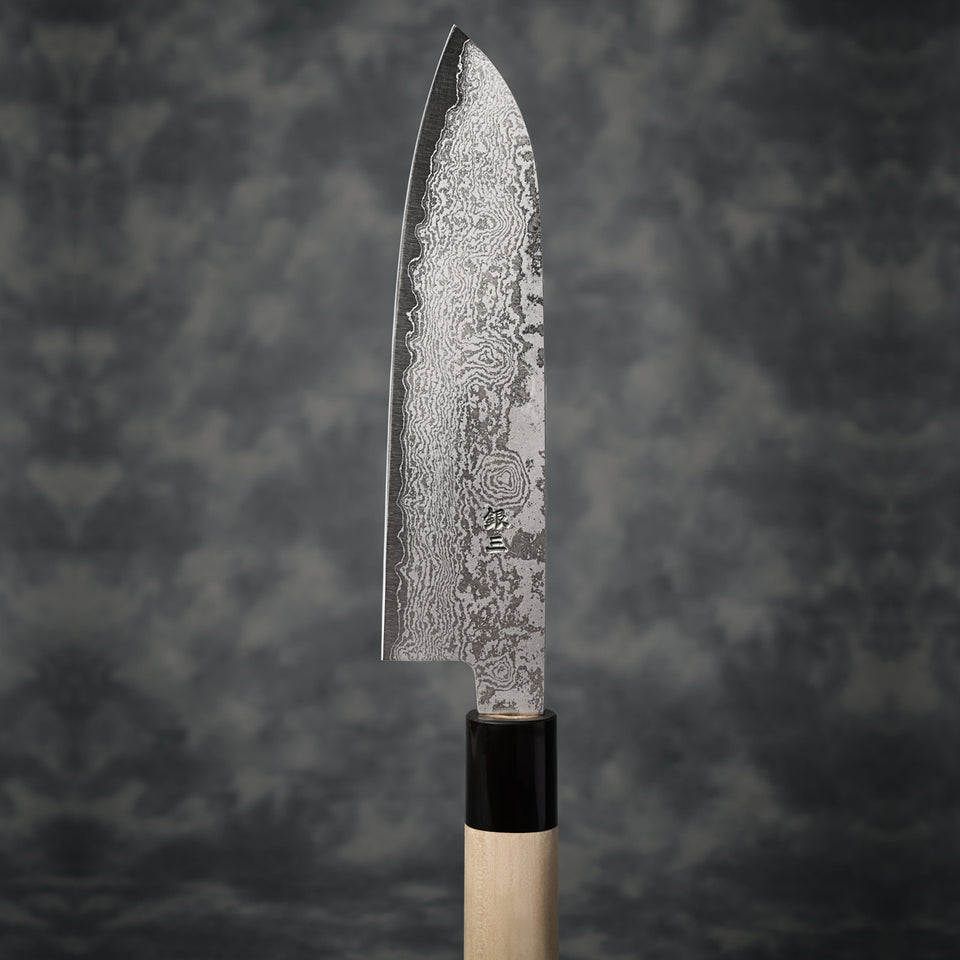
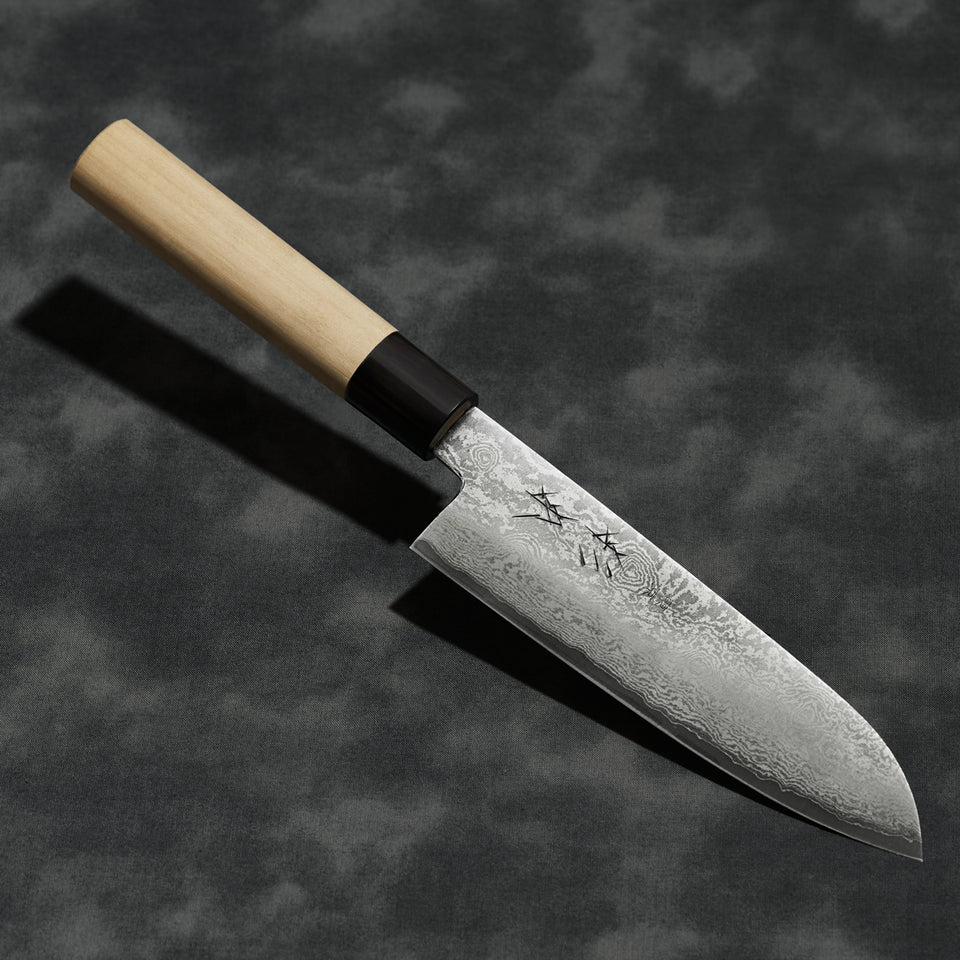
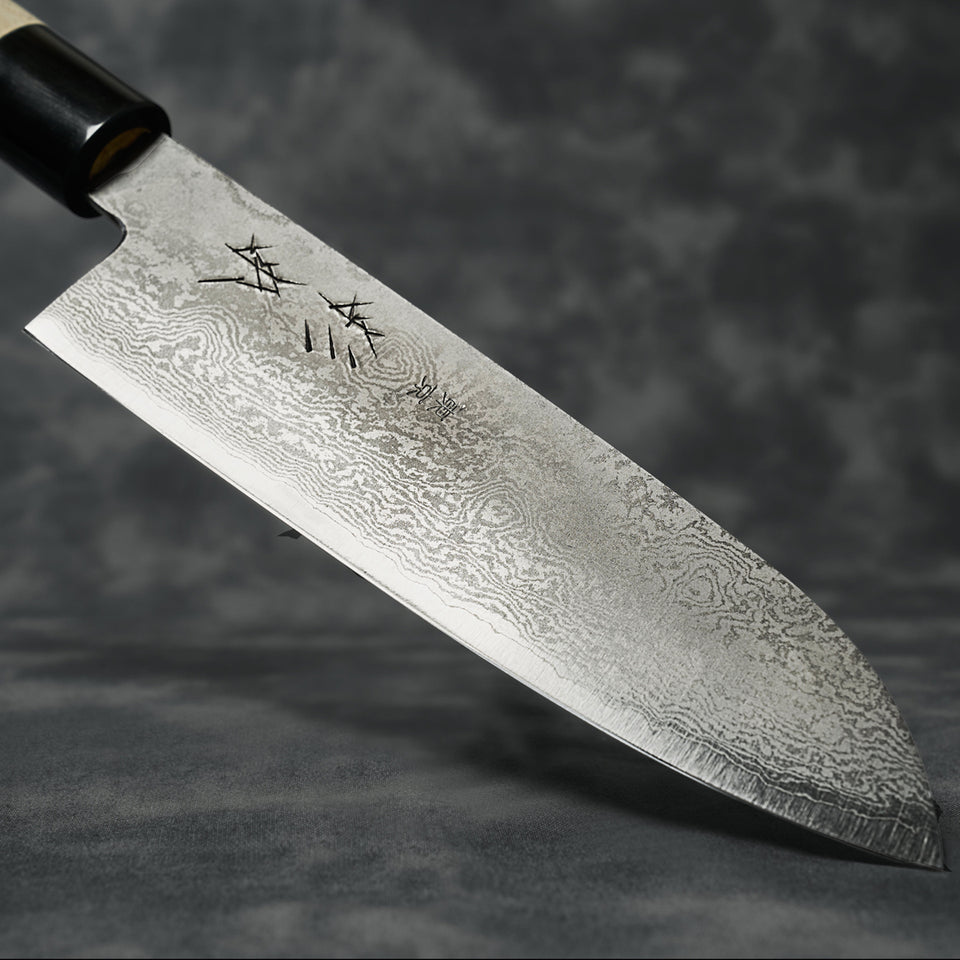
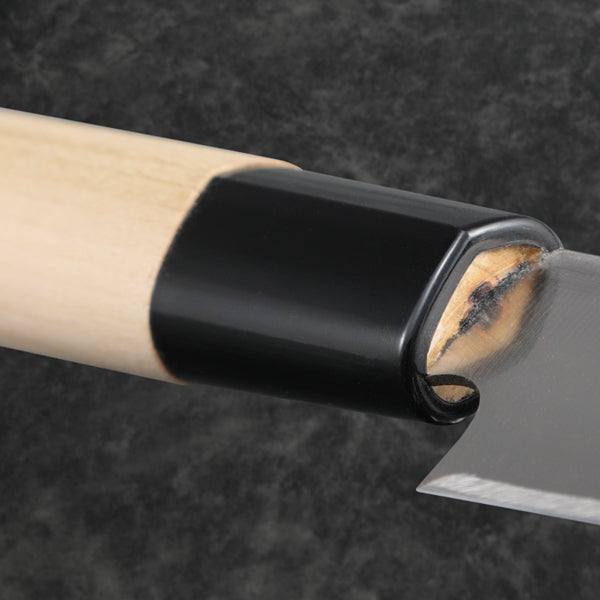
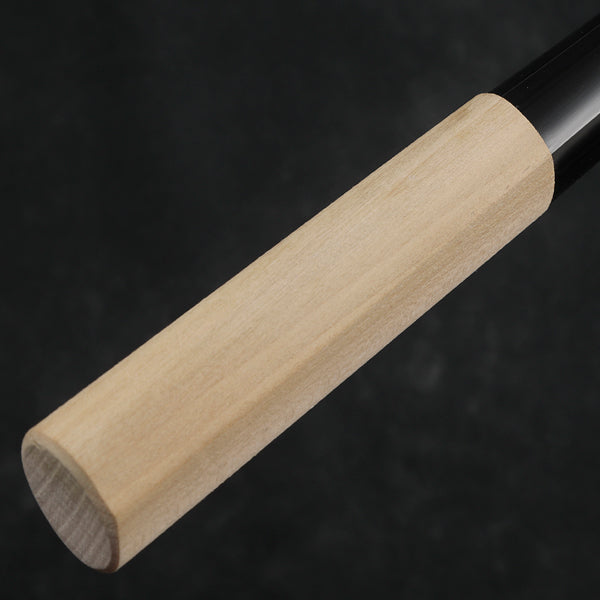
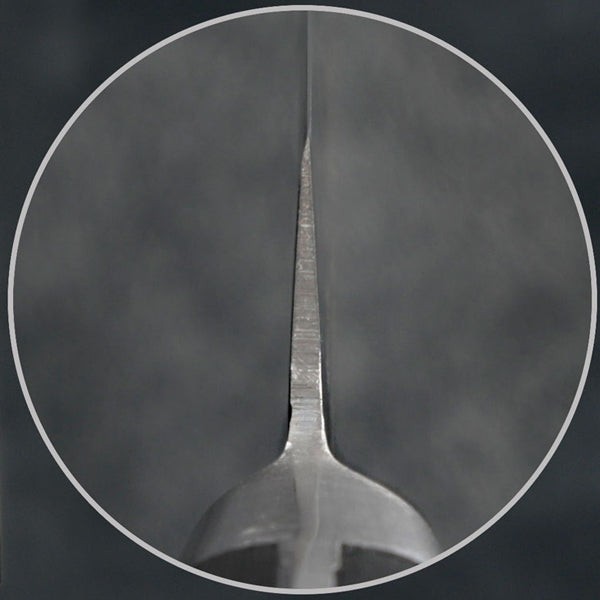
If you would rather own a blade made the old way than make one, the Bunka knife I carry was hand-forged by the swordsmith Ueta Sukesada (上田祐定) using the same traditional methods.
Inside the Exam
Eight days. One blade.
The task is a wakizashi in shinogi-zukuri, the standard ridged cross-section, of roughly one shaku three sun, about 39 cm (15 in). Roughly a week of work, from steel to finished form, is watched.
What is being judged is not artistry. It is whether the candidate has acquired sufficient technique to be entrusted with making swords at all. Kubo, who has served as a practical instructor since 2012, described the weight of it from the other side of the table: the trainees' lives were riding on the result, which made the judging anything but simple.
And here is the sentence the rest of the article turns on, from a different smith recalling his own sitting.
The exam, he wrote, can be passed on the minimum technical ability required to make a sword. What is genuinely hard is not the test. It is afterward, once you are independent, because an arm that barely scraped a pass will not feed you.
He added that he had been a poor trainee himself and was in no position to lecture anyone. That admission is worth more than the advice.
Pass, complete the five years, and the first application goes to the Commissioner of the Cultural Affairs Agency.
What It Costs to Train
Apprenticeship is not a job. The association says so directly: think of it less as employment and more as attending a vocational school to learn a technique.
The difference being that most vocational schools do not ask you to swing an 8 kg (18 lb) hammer.
Terms vary by forge, but the old live-in arrangement has largely disappeared. Most apprentices rent an apartment near the workshop and commute in, which means rent, food, and everything else comes out of their own pocket. At some forges there are also materials and facility charges of around 30,000 to 50,000 yen a month, roughly $200 to $330.
Tuition, at most places, is not charged. So the master is not profiting. Nobody in this arrangement is.
Five years of that, at eight hours a day, five days a week.
The obvious question is whether you can hold a part-time job alongside it, and the association's answer is careful. Some forges allow it.
But completing the Agency's session is difficult even for someone who has done nothing but train, and taking outside work means starting with a time handicap. Then it reframes the goal entirely: the target is not passing the exam. The target is standing on your own as a full-time smith.

Going Independent
Approval arrives. Now you need somewhere to work.
A new building of three by four ken (間) comes to 12 tsubo (坪), the unit Japanese builders and estate agents actually price in. The ken is the module Japanese timber buildings are laid out on, about 1.82 m (6 ft) between pillars. Twelve tsubo is around 40 m², or 430 sq ft, or 24 tatami mats laid out flat.
That, plus a minimum set of machinery, runs to around 10 million yen, something like $67,000. It can be brought down by building cheaply and buying used machines, but that is the number a newly licensed smith is looking at after five unpaid years, and there is no institution standing by to lend it.
Then the question of where to put it, which has an answer most people do not anticipate. Not in a residential area. The work is loud, and charcoal throws a great deal of dust into the surrounding air.
Without genuine understanding from the neighbors, the association says, it is not possible. So a forge ends up outside the cities, away from residential streets, and away from where the buyers are.
Read all of that as a business plan, and it does not survive contact. Five years of unpaid labor, a $67,000 setup cost, a production ceiling of roughly two blades a month, most of each blade's price paid out to other trades, and a customer base of collectors, shrines, and museums.
Nobody enters this trade on a business plan.
What the license permits is the making of one specific kind of object: a blade with value as a work of art, produced by a method that has to be carried in a person's hands because it has never been fully written down. The state's interest in it is preservation. The smith's interest, judging by how smiths actually spend their time, is the same.
Look at what Kubo did after receiving approval in 1994, at the point where a business would start recouping. He spent the next six years training as a murage candidate, learning to run the smelt that produces the steel. It was a second apprenticeship, in a second trade, that no customer would ever ask him about.
He took a research post at a metallurgical laboratory. He published in a steel-industry journal. He spent years chasing utsuri (映り), the misted figure in Kamakura-period Bizen blades that modern smiths had written off as unrecoverable, and got it back in 2007.
None of that sells more swords. All of it recovers something that was slipping away.
The same logic explains the rest of the picture. Most licensed smiths have other income, and that usually gets reported as a symptom of decline. It is at least as reasonable to read it the other way: outside income is what allows the work to continue at a scale the market alone would not support.
Blades still go to shrines as dedications. The forge still has a deity in it. What the smith is making is not only merchandise, and never has been.
This is also what Kubo is warning apprentices about when he asks them every morning when they intend to quit. The warning is not that the money is bad. It is that money will not be a sufficient reason to stay, and anyone whose reason stops there will leave at the first hard winter.
The building costs 10 million yen because a forge is expensive. It gets built anyway, in a field, at the far end of five unpaid years, by people who have decided the thing being made should continue to exist.

What One Sword Costs to Make
The association publishes a breakdown, and it rewards close reading.
| Item | Cost (yen) | Approx. USD |
|---|---|---|
| Tamahagane (raw steel) | 30,000–60,000 | $200–400 |
| Charcoal | 200,000–300,000 | $1,330–2,000 |
| Polishing | 250,000–400,000 | $1,670–2,670 |
| Habaki collar | 80,000–200,000 | $530–1,330 |
| Scabbard | 80,000–120,000 | $530–800 |
| Sword bag | 2,000–5,000 | $13–33 |
| Manufacture approval application | 800 | $5 |
| Registration | 6,300 | $42 |
| Total | 600,000–800,000 | $4,000–5,330 |
Plus utilities, files, whetstones, and everything else that wears out.
The association rounds its total to about 600,000 to 800,000 yen. When I add up its lines, the range runs from about 650,000 to almost 1.1 million yen, so the rounded total sits on the optimistic side.
Two things jump off that table.
Charcoal costs five to seven times what the steel costs. The material the sword is famous for is among the cheaper line items. The fuel to work it is not.
Polishing is the single largest expense, and it is not the smith's work. Add the polisher, the habaki maker, and the scabbard maker together, and roughly 410,000 to 720,000 yen of a sword's cost leaves the forge for other people's workshops. That is most of the total.
The smith's own consumables come to something like 230,000 to 360,000 yen. Everything above that is paying the rest of the chain. Financially, the smith is a minority stakeholder in the object that carries their signature.
And a last piece of arithmetic. At the two-a-month rhythm the trade works to, a smith running flat out at twenty-four blades a year is committing something in the region of 14 to 19 million yen, or $96,000 to $128,000, in costs alone, before earning anything.
There is no volume solution available. That is the shape of the profession.
Approval Is for Swords, Not for People
English coverage describes a swordsmith's license. Japanese law does not quite issue one.
What exists is seisaku shonin (製作承認), approval to manufacture, granted per application under Article 18-2 of the Firearms and Swords Control Act.
The first application goes to the Commissioner of the Cultural Affairs Agency. It carries the full weight of requirements: five continuous years under an approved smith, certified by that smith, guaranteed by two or more registration examiners, with the Agency's training session completed.
Subsequent applications go to the prefectural board of education. The requirements are correspondingly narrower. The blade must have value as an art object, and the maker must be someone who has previously been approved.
The five-year clause has done its work and falls away.
So there is no license certificate sitting in a frame. There is a first successful application, after which the ordinance describes the person simply as someone who has previously received approval.
The wording is deliberate. Article 2 uses tosho (刀匠) for the approved smith who certifies the apprentice, then switches to the plain 者, person, for the one who has been approved before. The law names a qualifying relationship and a condition. It does not create a professional title.
What the law does issue, each time, is a shoninsho (承認書), an approval document for those specific blades.
What Every Application Declares
- The applicant's name and address
- The maker's name and address, if different
- The maker's date of birth and career history as a smith
- The name and address of the person who commissioned the work
- The type and number of blades, including the number of kagenuchi (影打ち), the additional blades forged alongside the intended one
- The purpose of manufacture
- The place of manufacture
- Scheduled start and completion dates
- Any other matters that may serve as reference
Two duplicate copies attached.
Read that list again and the whole system comes into focus. Who ordered it. Why. Where it will be made. When work begins and when it ends. Every blade, declared in advance, for a career.
The Limit That May Not Be a Limit
The trade works to a rhythm of two long blades a month (tachi, katana, wakizashi), or three a month if tanto are included. Twenty-four a year, thirty-six with short blades. Ask any smith, and that is the ceiling they will name, and English sources state it as law.
The swordsmith Matsuda Tsuguyasu went looking for the text of that law and could not find it. Through a member of the Diet, he put the question to the ministry and received a written reply: no numerical limit is imposed. The guidance is that a sword should take about two weeks to make properly. Smiths had done the arithmetic themselves, two weeks per blade and so two blades a month, and then treated their own arithmetic as statute for decades.
Matsuda says he can reach quenching inside a week and get a blade to the polisher in ten days. He had spent years slowing down for a rule the ministry then told him did not exist.
For decades the trade has followed roughly two swords a month, but the evidence suggests this is administrative guidance and long-standing practice rather than an explicit legal ceiling.
Though when an entire profession believes a number, the number does the work of a rule regardless.
The Signature and the Certificate
When the blade is finished, the tang is filed, the peg hole cut, and the nakago (茎) inscribed, with the smith's name on one side and commonly the date of making on the other. Museums mount swords so the signed face shows.
Then it must be registered. Every sword lawfully held in Japan carries a juho tokenrui torokusho (銃砲刀剣類登録証), issued by the prefectural board of education. Not the police, which tells you how the state classifies these objects.
The certificate is about half the size of a postcard. It records type, length, curvature, peg holes, and signature. It does not record the owner. It travels with the blade forever, through every sale and inheritance, and no one can lawfully possess a sword without one.
What the Blade Has to Be Made Of
Two things get a blade registered: it was forged and hardened by traditional means, and it has value as an art object. Both are about method.
Neither says anything about where the steel came from. That wording keeps foreign blades and machine-made wartime production out, because those were made without folding and without a true hamon (刃文).
In practice, this means tamahagane, and most licensed smiths use steel distributed through the NBTHK. It is allocated rather than sold on an open market, which puts a queue between a newly approved smith and the material.
But Japanese law does not require the steel to be purchased from the NBTHK. Self-smelted tamahagane is possible, and a small number of smiths work that way. What the state examines is how the blade was made.

How Many Are Left
Nobody publishes an annual count of working swordsmiths, so every figure in circulation is an estimate with a method behind it that usually goes unstated.
Recent estimates place the number somewhere between about 180 and 300, with around 200 often cited. One figure that gets repeated puts it at 188 as of 2017, against roughly 300 in 1989.
That number counts everyone who has ever received approval, and approval does not expire. The working count should be much smaller.
How much smaller is genuinely unknown. The figure passed around, that only a few dozen support themselves entirely by swordmaking, traces to blog posts rather than to any survey, and is better treated as trade folklore than as data.
What the cost table makes clear is why the smaller number is plausible.
Someone producing at the trade's full rhythm is laying out somewhere around 14 to 19 million yen a year in costs before earning anything, selling into a market of collectors, shrines and museums.
Most licensed smiths have other income. That is not a decline so much as a cost problem.
The Other Hands on the Blade
A finished sword is the work of at least seven trades, and has been for centuries. Only one of them is the smith.
The Seven Trades
The toko (刀工) shapes the steel, hardens the hamon, cuts the signature into the tang, and does a rough polish, kajioshi, until the blade's final form can be seen. Then it goes out of the workshop.
The togishi (研師) polishes. More than ten separate stages, and a blade of the length most people picture, around 70 cm (27.5 in), takes roughly ten days to two weeks.
The finishing stones are still natural stone quarried in Kyoto, because no synthetic equivalent has been made that works at that stage. The last step in finishing a Japanese sword depends on a hole in the ground.
Polishing is subtraction, and irreversible. Every pass removes metal that does not come back, so a sword's best condition is the one requiring the least polishing. A botched polish can be fatal to a blade, which is why restoration is left to specialists as an absolute rule.
The shirogane-shi (白銀師) makes the habaki (鎺), the collar at the base of the blade. A small piece of metal, easy to overlook.
It holds the blade steady in the scabbard so nothing rattles against the edge. It shields the junction where the blade meets the fittings, which is the fragile part. It also fixes the proportions. Take the habaki off and the sword looks unbalanced.
Makers in different regions shape them differently, so owners choose one to match the blade and its mounts.
The sayashi (鞘師) carves the scabbard from ho (朴), magnolia, shaped to one specific blade and no other. Two Japanese idioms come from this, one about returning to the original scabbard and one about curvatures that do not match.
Inside, the blade rests on a few points of contact only, so the interior must hold it securely while letting it draw without ever touching an edge.
The tsukamaki-shi (柄巻師) wraps the hilt, which is not simply winding cord. The cord is chosen based on the position of the mekugi peg hole.
The skin underneath, samegawa (鮫皮), is called shark skin, though it is usually ray in practice, and it must be selected and prepared. And the hilt the sayashi made gets shaved down so the wrap finishes cleanly.
The nushi (塗師) lacquers the scabbard exterior. The relationship runs deep enough that some urushi techniques were developed specifically for scabbards.
The kinko-shi (金工師) makes the fittings: tsuba, menuki, kozuka, kogai, fuchigashira. By the Edo period, the tsuba had drifted from function toward appreciation, and elaborate work turned it into an art object the size of a palm.
Carving on the blade itself is often this trade's work too, though smiths sometimes do their own.
Almost none of this happens where anyone can watch. Workshops are not open to the public, and the exceptions are occasional, such as shrine dedication rites and demonstrations at craft events.
The Bizen Osafune Sword Museum in Setouchi, Okayama, is the rare place where the workshop can be seen year-round.
Three Slots a Year
Here is the part that should worry anyone who cares whether this continues.
The NBTHK runs annual training for these trades, in parallel with the smiths' program. Polishing has run since 1968 and kajitogi since 1974, alongside shirasaya and mountings, hilts, and habaki, with the same three-year structure and the same three tiers.
Intake is roughly three people per tier per craft. Five slots for polishing auditors. Three for everything else.
Applicants at the upper tiers must work in the trade professionally and must supply a letter of recommendation from an instructor or former instructor. Which means the recommendation problem does not end at apprenticeship. It follows you through the profession.
That is the national pipeline for scabbard-making. Three people.
Women Who Made Swords
There was never a single, universal rule governing women's access to Japanese swordmaking. Individual forges and traditions had their own restrictions, and some were serious, but nothing timeless or nationwide governed the whole craft.
The modern record is sparse enough anyway. As of 2020, no woman held the swordsmith qualification, against roughly three hundred licensed men.
The physical argument gets made constantly, and it is not empty. The ozuchi (大槌), the great hammer, runs about 8 kg (18 lb). A writer who was handed one described lifting it overhead easily enough, then finding that landing it accurately, on the exact spot, repeatedly, at speed, was another proposition entirely. It is punishing work for anyone.
But an absence in one register is not an absence everywhere, and the historical record has people in it.
Otsuki Gen
In the middle-to-late Edo period, a smith worked in Bitchu, the western part of present-day Okayama Prefecture, under the name Onna Kunishige (女国重), Kunishige the woman. Her name was Otsuki Gen (大月源), known as O-Gen, daughter of the smith Otsuki Denjuro, born into the Ebara Kunishige line that descended from the Bitchu Mizuta school.
What follows is an itsuwa, a handed-down story rather than a documented biographical record.
Her father died when she was sixteen. An uncle raised her, and when she was twenty-one, he fell ill himself. He asked her not to let the line die, and taught her the school's methods orally, which is how they were transmitted.
She struggled with it. She made a hundred-day vow at the local shrine, and not long after met Nobukuni, a smith from Tsukushi in what is now Fukuoka, traveling the provinces to train. He saw what she had and taught her properly. Her blades became known well beyond the province.
She married the twelfth Jinbei Kunishige, a smith like her father and her uncle. Illness stopped him from forging. So she forged to keep the line alive, and taught the technique to her son.
She died in 1808, aged 76.
Several of her blades survive. All tanto, none longer than one shaku, about 30 cm (12 in), most likely because the long blades demanded a body she did not have. A portrait her son commissioned from a Kano-school painter survives too. She is remembered as small, solidly built, with thick arms, which is entirely plausible to anyone who has lifted an 8 kg (18 lb) hammer.
Whatever the story has picked up in the retelling, the shape of it is what matters. She received a school's knowledge, worked with it, and handed it on. That is what the craft asks of anyone.
The Trades Around the Blade
Only the smith's work carries a national qualification. The other trades have none, which also means no register, and no reliable count of anyone in them.
The figures that exist come from inside the trade. As of 2020, women working as togishi, apprentices included, numbered around five or six out of perhaps sixty to seventy polishers in total. Two or three shirogane-shi out of fifteen to twenty. One or two tsukamaki-shi out of roughly ten. Three or four kinko-shi out of fifteen to twenty-five. Lacquerers are harder to count, since most do not work on swords exclusively.
Small numbers inside small numbers. And in every one of these trades, working at it full-time is rare regardless of gender.
The Steel-Maker
The sword begins before the smith, at the smelt.
Tamahagane comes only from tatara (たたら), and the person who runs a tatara is the murage (村下), its technical head. Charcoal and iron sand go in at the top, and roughly an hour passes before what goes in reaches the bottom, so every decision is made an hour ahead of its result, read off the color of the fire and the behavior of the air.
Hirata Nodoka (平田のどか) does that work at Hirata Tantojo in Ome, Tokyo. She grew up in Okayama, interested in traditional things, kimono among them, from early on. She learned tatara from her husband, the smith Hirata Sukehira, and has run the smelt since 2019, the year the two of them went independent. She has been described as the only woman in the world working in the role.
She is the murage (村下); he is the toko. Most of Japan's roughly three hundred smiths work from the same allocated steel. Their workshop makes its own, which is what the division of labor buys them.
As the couple's knives drew attention, so did the messages. A woman had no business in the forge, they said, and should not be involved in making Japanese swords. The old prohibition existed for a reason. She has answered that she has broken no tradition except by being born a woman, and that the iron comes out fine. She has also said she wants to see more women working in the sword trades.

Hirata Nodoka at work over the fire. Photo: @hirataswordsmith on Instagram.
She has never claimed to be a swordsmith, and that is the point worth making. The trade is a chain of specialists, and she holds a link almost nobody holds.
A Tradition That Changed
Some forges kept women out, and the reasons were real to the people holding them.
Forging was treated as a religious act. A kamidana sits in the workshop, and smiths purified themselves before beginning. Around that sat a cluster of beliefs shared with the other trades that handle fire, iron, and the mountains, such as mining, charcoal-burning and forestry, in which women near the work were said to anger the deity of the place.
Kanayago-kami, the forge's own deity, is usually the one named, and jealousy is the reason given. At the level of a single workshop it came down to something blunter: the blade would not harden, the fire would die.
Those were many customs rather than one rule, varying by region and by trade, and none of them was law.
The rest of the history is patchier than the stereotype suggests. "The sword is the soul of the samurai" surfaces around the end of the Edo period, and nothing followed it instructing women to keep away.
Pre-Edo paintings show no women at swordwork, but those images routinely depicted things other than as they were. Wartime photographs from the twentieth century show factory floors full of women polishing blades.
None of those customs forms part of the modern qualification system. What governs entry today is approval. That means five years, certification and the Agency's examination, and that system asks about training and skill.
Which puts the question somewhere more useful than who was once permitted to stand beside the forge.
Customs change. The people practicing a craft change. What decides whether a craft survives is whether its knowledge and its standards go on being learned and handed to somebody else.
Can a Foreigner Become a Swordsmith?
Nothing in the ordinance mentions nationality. The Swordsmiths Association's own answer is nonetheless discouraging: smiths willing to accept a foreign apprentice are, in their phrasing, close to nonexistent, with language and visa problems behind that.
The most instructive case supports both halves of that.
Johan Leutwiler grew up in Monthey, in the Swiss canton of Valais, where his older brother apprenticed at an ironworks and taught him basic ironwork at home. He began the same apprenticeship as a teenager. Not long after, he saw a Japanese sword at an exhibition, probably a fake, he says, and the interest took hold.
He did not set out to become a swordsmith, for the simple reason that he could see no route. No foreigner had done it, and he had no idea how one would even begin. So he took the only path toward swords he could find and started iaido and kenjutsu at eighteen. He kept that up for ten years.
The dojo conducted practice using Japanese terms, which pulled him toward the language. He began studying Japanese at around twenty, and took up calligraphy.
He first visited Japan in 2012 and describes realizing within a week that this was where he belonged. It took another five years to get back. There was work, then compulsory military service, then a stretch he describes as the hardest of his life.
He arrived in 2017 and went to language school for a year and a half before approaching anyone about apprenticeship. His reasoning is the whole argument in one line: if you cannot communicate with your master, there is no point, and since a master will not teach you everything piece by piece, you need to be able to read the books yourself.
Then he attended the Swordsmiths Association's session for prospective entrants and met the smith who would take him. That smith was Kubo Yoshihiro, who created the session in the first place.
When the candidate was Swiss, nobody else would take him. Kubo asked around, including a former apprentice of his own, and the answer came back no. The concern was language, every time. So he took Johan himself, reasoning that a man who had worked in an ironworks had the physical capacity and the feel for making things, and that someone who said he did not want to go back to Switzerland was serious.
Then he asked him every single morning, for about a year, when he was going to quit.
That was not cruelty. Kubo's position is that going easy on an apprentice does them no favor, because what waits after independence is worse: finding the money for polishing and scabbards, finding customers, working through the flaws in your early blades, and having nothing to build a workshop with. He has known plenty of people who left at that stage. Better, he says, to scatter some stones and nails in the path before someone has to walk it alone.
His broader hesitation about teaching foreigners is worth stating in his own terms rather than softening. He does not think teaching the technique is straightforwardly a good thing.
Books and videos are everywhere now, but nobody makes a fine sword from a video. It takes one-to-one correction on details, over years. Teach all of that to someone who then returns to Europe and trains apprentices there, and the technique has left and will not come back. He committed to teaching Johan fully only after confirming he intended to spend his life in Japan.
He put it plainly: the sword is an important part of Japanese culture.
Johan trained on a cultural activities visa. In 2024, he passed the examination and received manufacturing approval from the Cultural Affairs Agency, and the Japanese government recognizes him as the first foreigner to do so. I have seen one older claim. A California sword club describes the American Keith Austin (Nobuhira), who trained in Japan and died in 1997, as licensed, though collectors dispute it.
Five years under Kubo, then the week in front of the judges, then the paperwork that every smith files forever. He signs his blades Mitsutsuna (光綱). He works between his master's forge in Shobara and his own workshop in Mihara, Hiroshima, and in the 2025 Contemporary Sword Artisans Exhibition he took a first-place Effort Prize and the Newcomer Prize in the forging division.
The Mihara workshop came out of a municipal program for vacant houses. He bought an akiya (空き家) there and converted it into his finishing space, which the city put on its own website.
Rather than knock the old house down and replace it, he has written, it seemed worth using what was already standing and letting it be reborn, and it happened because Mihara and the people around him were willing to make room for it.

Johan Leutwiler checking a blade. Photo: @johanleutwiler on Instagram.
Which is where the association's discouraging answer and this article's accounting finally agree with each other.
Nothing forbade it. Everything made it improbable. What closed the gap was ten years of iaido before he ever set foot in a forge, a year and a half of language school before he asked anyone for anything, a smith who built the entry session precisely so that people without connections could be found, and a stated intention to spend the rest of his life in the country.
It took him roughly fifteen years from the sword in the display case to the license.
Not impossible, then. The association's answer was accurate on the odds and wrong on the ceiling, which is the most useful thing an answer can be.
Is There an Age Limit?
Not in the law. Read the ordinance, and you find conditions about training, about who certifies you, about whether your technique is good enough. Nothing about age. A master who takes on a forty-year-old starts the same clock as one who takes on a school leaver.
Where age does bite is the introduction.
The association's newcomer track is capped at thirty. That is the workshop's rule, not a licensing rule, but it matters because of what the workshop actually provides.
Three days at the Bizen Osafune forge puts you in a room with working smiths and with people currently apprenticing, and the instructor's recommendation is what opens the trial apprenticeship and, after that, the introduction to a master. The trade runs on introductions.
So the session is less a course than a way of acquiring the relationships that most applicants do not have. Past thirty, that route closes.
What remains is the older method, which has no cap at all: study the smiths, go to the exhibitions, talk to makers at viewing events, work out whose work you want to make, and ask. Plenty of currently working smiths came in after university or after years in another career.
Kubo's own view of taking on a 28-year-old was that it was honestly late, but the man had worked in an ironworks, so the stamina and the feel for making things were already there.
The association still advises anyone over thirty to think it through again, and the reasoning is worth taking seriously rather than as gatekeeping.
The work is physical, and youth helps with how fast the skills go in and how much the body can take.
And the math is unforgiving in either direction. There are five unpaid years, materials to pay for, roughly 10 million yen for a workshop, then a reputation to build. Starting at thirty-five means selling your first sword under your own name somewhere around forty.
Age caps do appear further along. The NBTHK's advanced program takes kenshusei up to about 45 and tokubetsu kenshusei up to about 50, with auditors uncapped.
Neither is an entry limit. Both apply to training meant for people already in the trade. Work backward from 45, and you can see what the institutions expect a career to look like.
What Five Years Actually Buys
Five years is the answer to the question, and it is the least interesting part of it.
The five years assume a master, and masters are scarce, mostly not well off, and mostly reluctant. Clearing that is the real barrier, and the trade's own governing body says as much in plain language before it says anything encouraging.
The five years are unpaid, and cost money to serve.
The exam at the end of them certifies the minimum. A smith who sat it said the test is not the hard part. The hard part is afterward, when a barely-passing arm has to feed you.
The certificate is not the end of it. It is admission to a filing system, the right to apply, blade by blade, naming the customer and the purpose and the place and the dates, for the rest of your working life.
Then the workshop. Then the queue for steel. Then a market of collectors, shrines and museums, shared with somewhere between about 180 and 300 other approved makers, at a cost per blade of 600,000 to 800,000 yen, most of which leaves your hands to pay the polisher and the scabbard maker and the fitter of the collar.
After approval in 1994, at the end of his five years, Kubo took six more years learning to run the smelt. Metallurgy papers, a reproduction of a Kamakura-period effect nobody had recovered, top award at the national exhibition three times, Mukansa in 2017, the association's presidency in 2025. In 2024, he held a solo exhibition marking thirty years since qualifying.
The three-year NBTHK program exists because the license is not the finish. It is the starting line for competence.
None of which is an argument against doing it. It is an argument about what the object in the display case represents. A signature on a tang is one name on a chain of trades, at the end of a decade, filed in advance with the state, made from steel that came out of a clay furnace somebody watched without sleeping.
The five years of apprenticeship are a ticket to the road of swordsmithing. What you join at the end of it is the preservation of a piece of Japanese culture, not the regulation of a weapon.
Quick Reference
I converted yen figures at 150 yen to the US dollar, the approximate rate at the time of writing in 2026. Check the current rate before relying on the dollar amounts.
| Minimum apprenticeship | 5 years, about 8 hrs/day, 5 days/week |
| Qualification examination | Bijutsu Token Tosho Gijutsu Hozon Kenshukai (Cultural Affairs Agency), 8 days, once yearly |
| Exam task | Shinogi-zukuri wakizashi, about 39 cm (15 in), roughly one week |
| First approval granted by | Commissioner, Cultural Affairs Agency |
| Later approvals granted by | Prefectural board of education |
| Legal basis | Firearms and Swords Control Act Art. 18-2, rules of 1958, amended 1992 |
| Working output rhythm | 2 long blades/month (24/yr), not a statutory cap |
| Cost during apprenticeship | 30,000–50,000 yen/month materials, unpaid, own living costs |
| Workshop setup | About 10 million yen ($67,000) |
| Cost per sword | 600,000–800,000 yen ($4,000–5,330) |
| Registration certificate | 6,300 yen, issued by the prefectural board of education |
| Active swordsmiths | About 180–300 (estimate, around 200 often cited) |
| Licensed female swordsmiths | None as of 2020 under the modern system |
| First foreigner recognized by the government | Johan Leutwiler (Mitsutsuna), 2024 |
| Association entry session | Autumn, Bizen Osafune, 10,000 yen, newcomers up to age 30 plus an apprentice track |
| NBTHK advanced program | 3 years, Okuizumo, Shimane, after licensing, not for it |
Knives Made With Sword-Forging Methods




Get Free Bonus Books

Sign up for free to the Japanese Knife Club to get advice and exclusive articles about how to choose Japanese Knives, and tips and tricks for using Japanese knives.
About the author

Kei Nishida
Author, CEO Dream of Japan
Certifications: PMP, BS in Computer Science
Education: Western Washington University